

DERIK, Syria (North Press) – The 60-year-old Maryam al-Abdo is sitting among her grandchildren in front of her tent in Newroz camp in the countryside of Derik, northeastern Syria, waiting for any sign of the start of distributing winter supplies in the camp.
The displaced woman from the countryside of Tel Tamr, north of Hasakah, pointed to her tent, which has no blankets, rugs or mattresses.
“The tent is not set up on hard ground, the water leaks into it, we feel cold, we do not have any winter clothing, our tent’s floor must be leveled,” al-Abdo said.
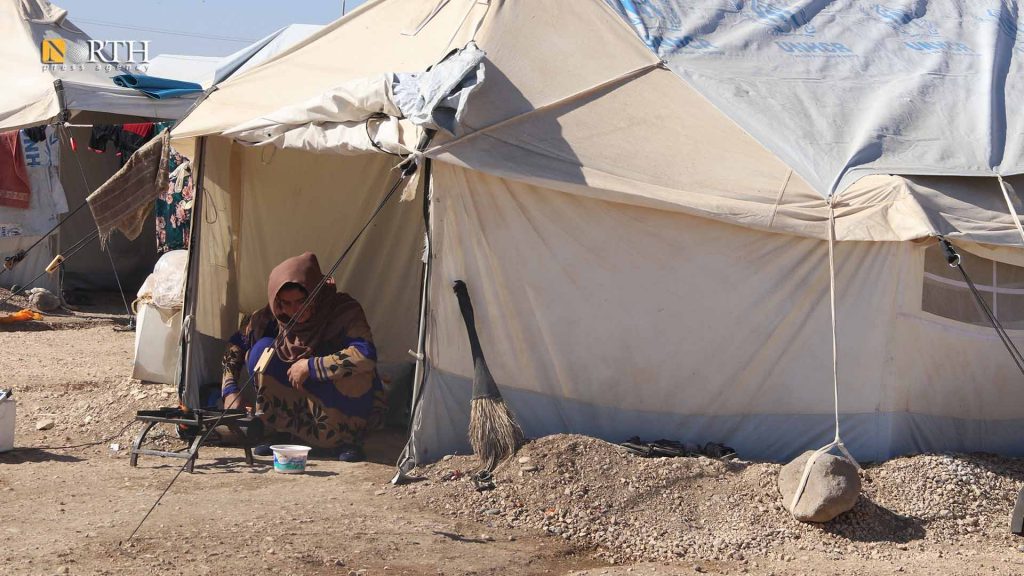
The IDPs are demanding the distribution of blankets, mattresses, winter clothes, heaters and fuel for heating, and to support the floors of the tents with cement before the temperatures drop and the rains fall.
They fear the delay in distributing these supplies and their shortage especially that the region witnessed the first rains of this year during the past two days.
They complain about their poor conditions and their inability to secure the needs of their families in light of the lack of job opportunities and they live in difficult humanitarian conditions, amid a lack of assistance provided for them by humanitarian organizations.
“We are suffering due to cold weather, we cannot sleep at night, our children also suffer, and we need everything,” al-Abdo added.
Children without winter clothes
Newroz camp, which was reopened during the Turkish invasion on Sere Kaniye (Ras al-Ain) and Tel Abyad in 2019, includes 715 families, in total of 3,420 persons.
The camp was established in 2014 with the aim of sheltering families fleeing from Sinjar district (Shingal), northern Iraq, after the Islamic State (ISIS) attacks.
Due to the recent Turkish attacks on the countryside of Tel Tamr town, north of Hasakah, dozens of families have been displaced to the camp amid a lack of humanitarian aid distributed by organizations.
Currently, 817 displaced families from Afrin, Sere Kaniye and Tel Abyad live in Newroz camp, in total of 4,173 individuals, according to the latest statistics of the camp management.
A winter basket aid will be provided for the IDPs, including winter clothes, blankets, and others, said Dijla Muhammad, official in Newroz camp, without specifying the quantity of these materials, the date of their distribution, or whether they would meet the needs of the IDPs or not.
However, she indicated, in an exclusive interview with North Press, the organizations have not yet shown their willingness to provide heating materials from kerosene or diesel.
The absence of organizations increases the fears of Ayda al-Mesleh, an IDP from the city of Sere Kaniye and the mother of a child who she fears will suffer from diseases due to the difficult situation.
“We are three persons; we share two mattresses and three blankets, they did not give us mattress, blankets, or even rags.”
“We live in dire conditions here. The UN has to provide us with aid. We need heating oil, heaters, and winter clothes for our children,” she said.
Closed crossings
There is scarcity in the aids distributed to the IDPs in squatter camps in northeast Syria with the advent of winter, Sheikhmous Ahmad, co-chair of the Office of Refugees and Displaced Affairs of the Autonomous Administration of North and East Syria (AANES) said.
“The supplies are not enough because the big number of the camps and the IDPs, the shortage of supplies is due to closing border crossings in face of the aids coming from abroad, and this affected negatively the camps and caused humanitarian and health crisis among the IDPs, Ahmad told North Press.
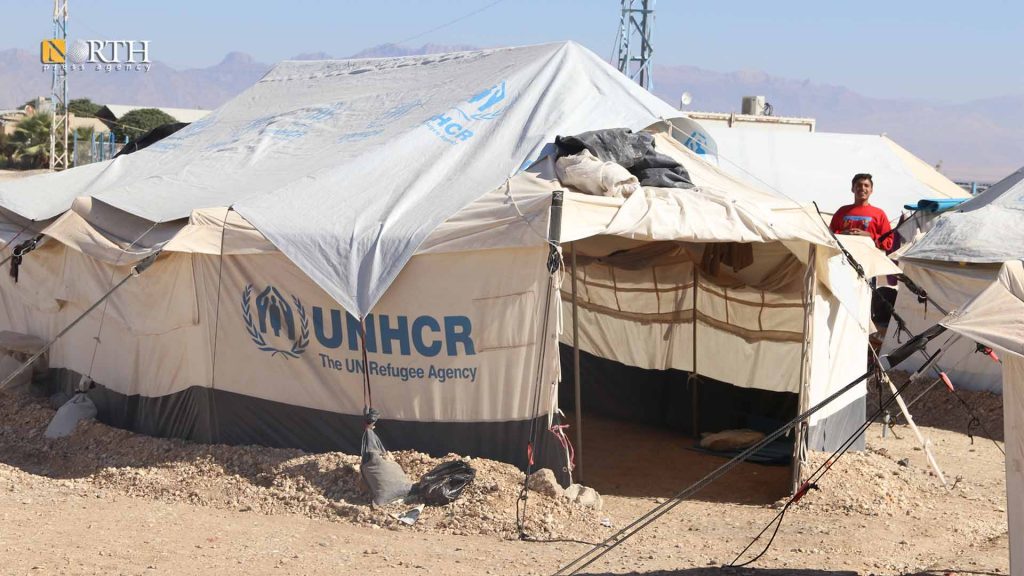
Tel Kochar (al-Ya’roubiyah) crossing, east Syria, has been closed to UN humanitarian access to northeast Syria since 2020 due to a veto used by Russia and China, which exacerbated the challenges facing the region.
Consequently, the region in general was affected by the resolution and caused insufficiency to the aids since Tel Kochar is the main corridor through which humanitarian assistance enters areas in northeast Syria, Ahmad added.
Currently, the humanitarian aids are limited and insufficient since they come through the road connecting the Autonomous Administration-held areas to government-held ones.
Health conditions deteriorated in squatter camps especially during the outbreak of Covid-19 recent wave and lack of medical assistance. Some coronavirus-related illnesses were transferred to medical posts outside the camp, Ahmad mentioned.
The camps are likely to suffer a medical crisis unless the World Health Organization (WHO) offers support, he concluded.
Fears of drowning tents
Recently and due to the escalation of the Turkish-backed armed Syrian opposition factions and their bombardment of inhabited villages and vital facilities in the towns of Tel Tamr and Zergan and their countryside, families from the countryside of Hasakah have fled to the camp.
Due to the increase in number of families fleeing their villages and the expansion of the camp, the tents were set up on soft ground without having a concrete floor like other tents, which frightens the new displaced from the possibility of their tents being filled with rain and mud.
Zahra al-Hassan, an IDP from the countryside of Tel Tamr, fears the upcoming winter due to her unequipped tent.
“When we first came here, the temperature was warm we could handle it, but now it is winter and very cold,” she said.
“Our tents are not well equipped, I only have two blankets and two mattresses. It is not enough,” she added.