
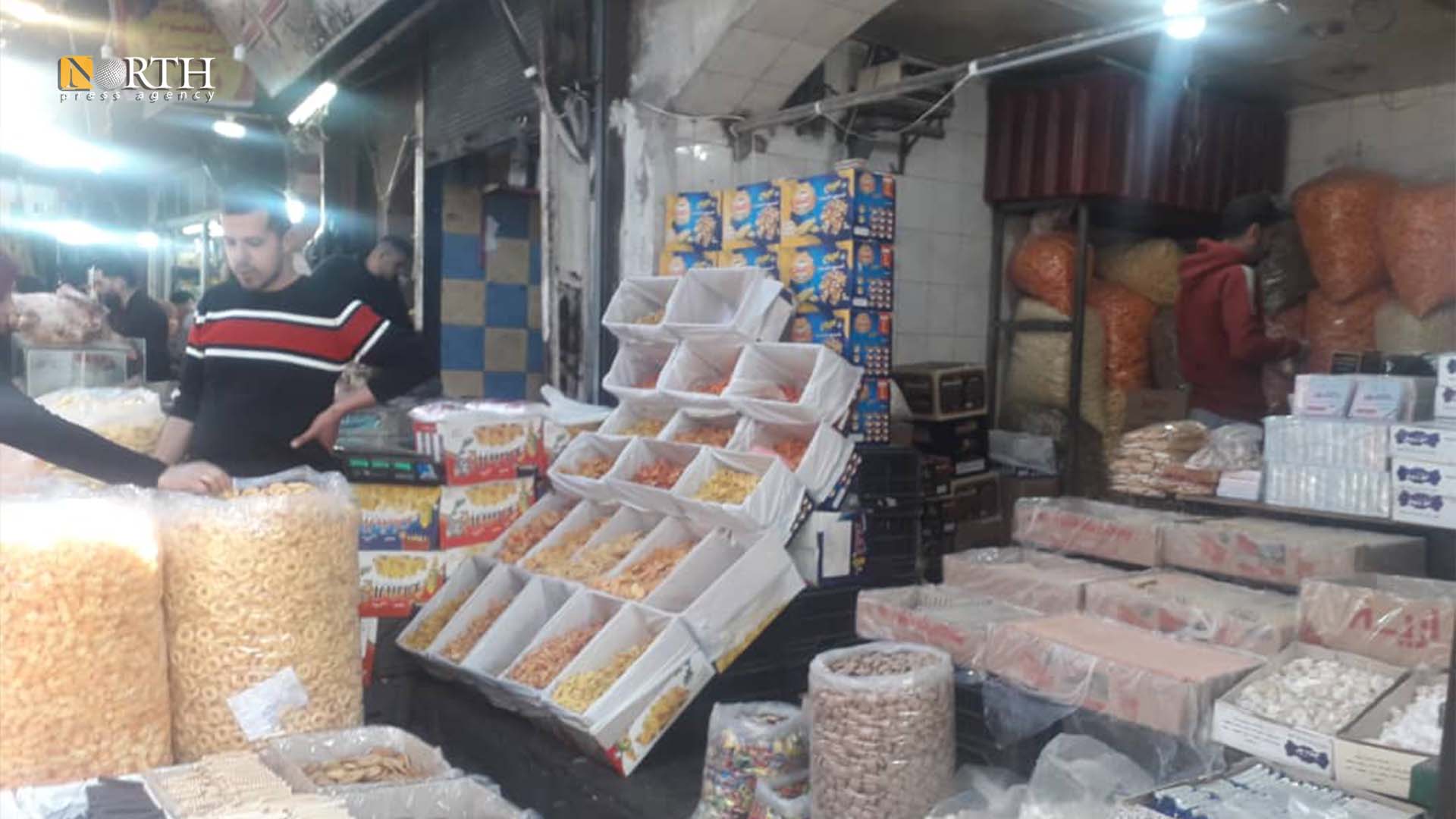
DAMASCUS, Syria (North Press) – Prices in Syria cannot be stable for one single day, as they witness several ups and downs due to exchange rate of the US dollar and the high prices, where consumers are obliged to pay for their basic needs according to the US dollar price, while they get their incomes in the collapsing Syrian pound.
This disorder pushed 90% of Syrians in Damascus and other Syrian areas to live under the poverty line according to estimates of an economic researcher, especially since the inflation rate reached more than 2000%, according to the estimates of the government’s Central Statistics Office.
Several decisions, a new consumer protection and price control decrees were issued by the government in addition to promises of imprisonment for violators, dismissing the governor of the Central Bank of Syria, and changing some exchange rates, cannot bring the high prices’ problem to an end, especially it is Ramadan now (holy Islamic month for fasting).
Mismatching bulletins and markets
Despite this problem, Ministry of Internal Trade and Consumer Protection is still issuing changeable price bulletins which mismatch with the prices of the market.
Khadija al-Abdullah (pseudonym), a retired employee, said that she cannot secure her own needs with her pension although she is responsible for only herself, so how parents or breadwinners can manage that.
While sellers in the market do not adhere to all imposed administrative prices, as they are not stable, according to them.
Ali al-Ahmad, a shop owner in Damascus, said that he was fined three times in less than three months, but he finds himself not obliged to adhere to the official price nor write the prices on the goods as he changes them every day, or even several times per day.
“I buy goods for high prices, so it does not make sense to sell at a loss!” he added.
“Not applicable”
A trader, who is aware of the trade movement in several markets in Damascus said that the exchange rates are unfair as setting the exchange rate of 1,260 SYP against the dollar have nothing to do with goods’ prices.
The trader believes that pricing “is unfair and is not applicable. However, they force the traders and industrialist to adhere to those inapplicable prices.
It is better to increase competitiveness, as it contributes to the prices’ decrease. In addition, the prices of any product cannot be decreased unless there are high competitiveness, available materials, transparency and flexibility of services.
Expenses and prices’ leaps
Some traders say that the Ministry of Internal Trade and Consumer Protection interferes in pricing everything, and it requires cost data for both manufactured and imported materials
The data about which there is disagreement, is the foodstuff, as it is sometimes imported at prices that do not match with reality as a result of customs privacy, so that the costs and data related differ, in addition to calculating the expenses of transporting of the customs broker.
A trader briefed the matter saying, “The issue is that the Ministry of Internal Trader does not take all expenses into consideration.”
While another trader said that the Ministry discovered that the data it prices do not match with the reality, so it has resorted to monitoring the prices of the market. Based on this, it will define the prices, provided that the seller’s prices do not exceed the defined ones.
A government employee of the Consumer Protection Department said that the reason for the gap and imbalance between the Ministry’s pricing and the market’s is in the method of modifying the ministry’s prices, which can be described as slow in comparison with price leaps in the markets.