
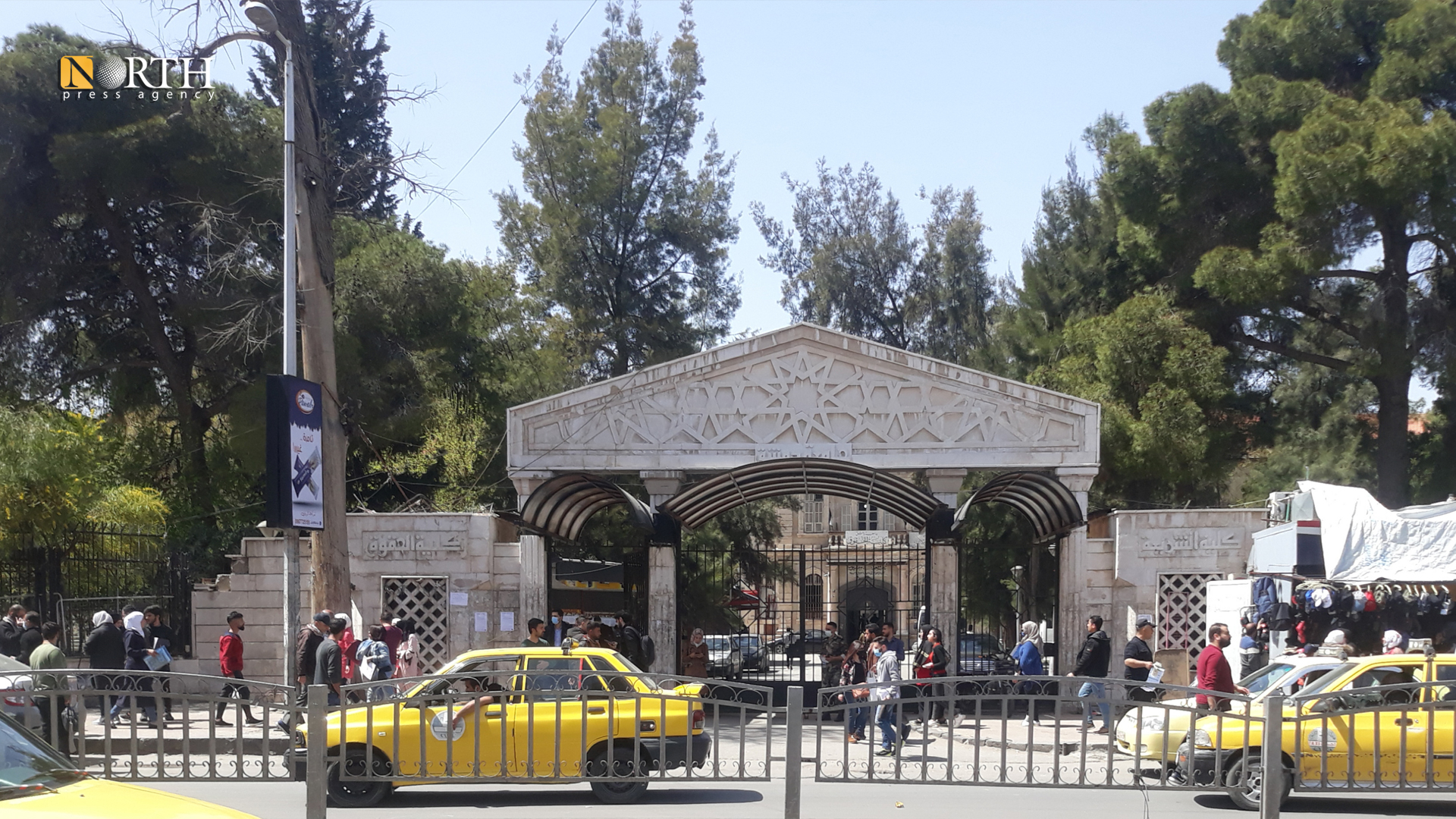
DAMASCUS, Syria (North Press) – The deteriorating economic situation in Syria has directly affected the stalls of Damascus University, and its students are unable to afford basic goods from university shops.
These kiosks provide various services and goods, including stationery, basic food, vegetables, hot drinks, and others, and students depend directly on them.
New difficulties for students
Rajeh Karman (a pseudonym), a student in the medical engineering department residing on campus, said, “The economic deterioration that is taking place today has become a real obstacle for me, and I may not be able to continue my studies at the university if the situation continues as it is, and I do not see a glimmer of hope.”
Karman indicated that his family are low-income earners, while he is unable to work in the evening due to his studies and the compulsory attendance of lectures.
He mentioned that he spends an hour every day going to the vegetable market in the nearby neighborhood, looking for the cheapest prices.
The prices of the stalls in the university campuses are high, as the prices are doubled in them compared to other markets.
“The price hike reached everything in the university: stationery, lectures, and food to an unjustified degree, and neither the university nor the Consumer Protection Directorate intervened to control them,” he added.
Screenshotting lectures
Lina Awad, a student at Damascus University in the Faculty of Architecture, told North Press that since last year, she gave up entering the college canteen, and never buys coffee or food from it.
The student, who hails from the city of Suwayda and lives in the university city, added that this year was the most difficult for her, because even after many luxuries became unattainable, the cost of basic materials sold in the stalls has doubled and she is unable to ask for more money from her parents who are government employees.
“I recently stopped buying the printed lectures to save on the cost, and I relied on photographing them from colleagues on my mobile so that I could study them and secure the cost of drawing paper and tools, which became a dream for some other colleagues,” Awad added.
The university’s annual revenues from its investments amount to about half a billion Syrian pounds, and the revenues of the shops and investments in the university city in Damascus are estimated between 150 and 180 million Syrian pounds per year, according to what was reported by the government-licensed Sham Times website on the authority of Mustafa Najjar, head of the cafeteria department at Damascus University.
Stall investments
Hassan Fidauddin (a pseudonym), an investor in a kiosk at Damascus University, told North Press that it is strange how everyone criticizes the high prices in the stalls without looking at the large cost of investment, and that the high prices affect the whole country.
He also mentioned that he suffered a great loss last year with the suspension of university attendance, which is repeated again this year.
He indicated that the exchange rate fluctuation and the high price of the goods do not allow him to comply with the 10% profit set by the university.
He adds that he has to compensate for the losses he suffered last year and this year, in addition to the investment value and bribes he paid in order to be able to win the tender.
“I feel the conditions of the students and their inability to secure their supplies, but there is no trick here, because I am hurt like them too,” he concluded.