
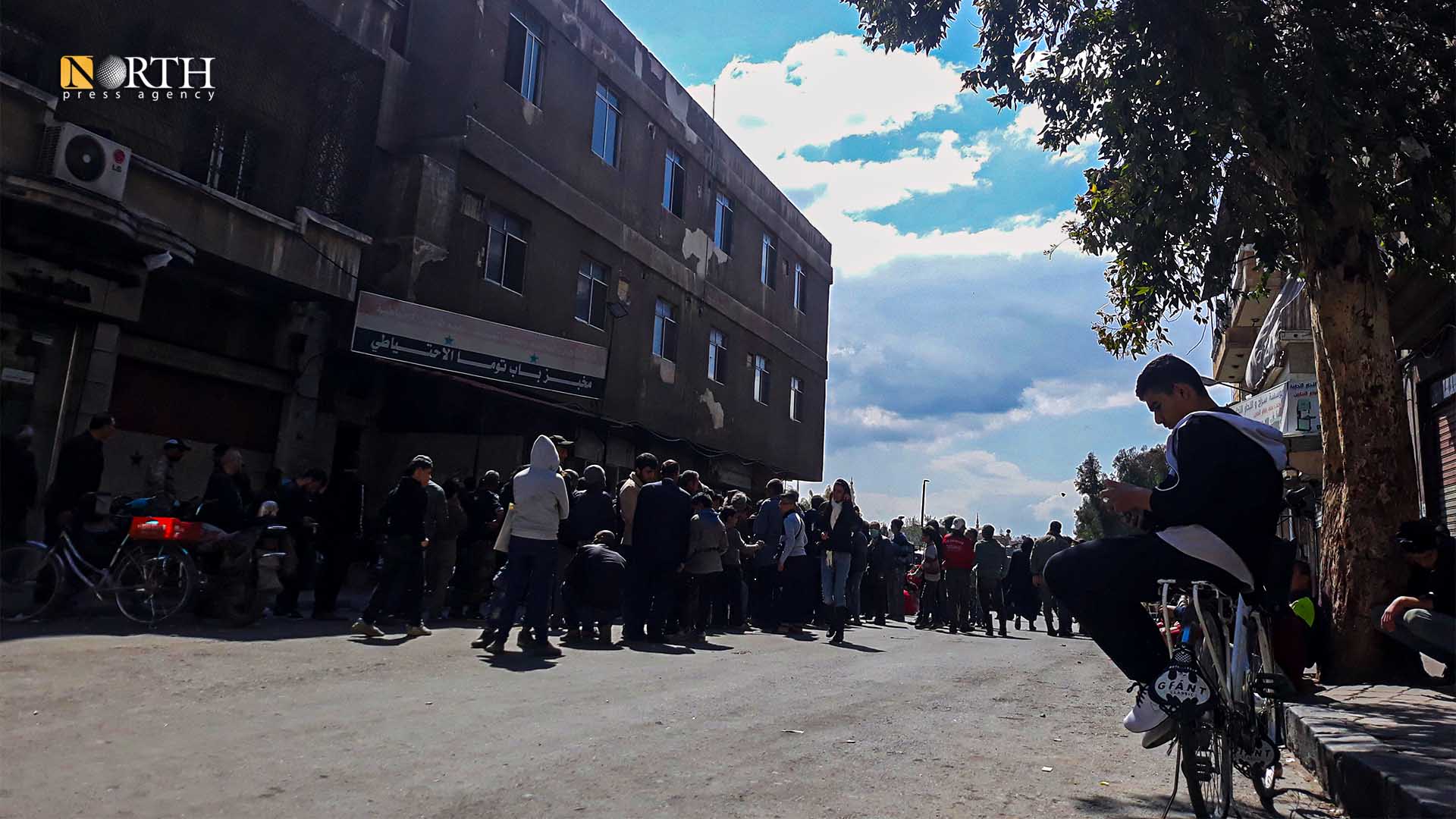
DAMASCUS, Syria (North Press) – Today, the family smart card becomes essential in the Syrian government-held areas. With this card, a family can obtain their small but vital allocations of heating oil, gas, bread, sugar, rice, and other goods.
In early 2019, the Syrian government began the smart card system, which allegedly aimed to stop monopolization of aid and provide support to those in need.
Errant Children
However, residents in the capital believe that because the single and divorced are considered “errant children,” the government has deprived them of a smart card so they cannot obtain their basic needs.
23-year-old Rojaih Mosawah, a medical student from Homs studying at Damascus University, said that he relies on his friends’ help in obtaining household gas and bread so that he can prepare food.
Mosawah, who is living in a rented house in Jaramanah, mentioned that he is lucky because he has a friend with a smart card who allows him to obtain a gas cylinder every six months.
“Regarding heating oil and the subsidized bread, I forgot about obtaining them,” he added.
He also uses gas as sparingly as possible to avoid bothering his friend who helps him.
27-year-old Lilian al-Awad, an architect working in an engineering office in the Halbouni, is forced, like many other girls, living in the capital, to use a travel-sized gas stove to prepare food.
Al-Awad, who visits her family in Suwayda occasionally, mentioned that she relies either on unsubsidized bread, sellers near the bakery, or what she and her roommates can carry during their visit to their families.
She added that finding other alternatives is financially exhausting, as the price of one kilogram of gas reaches 5,500 Syrian ponds (SYP), “which is higher than the price of a cylinder that contains about ten KG of gas.”
Absence deprives
If a mother is divorced or widowed, she will be deprived of her right to obtain a smart card, so she will not obtain her allocations of basic supplies.
Depriving this class of people contradicts the main pretext for releasing the smart card, which aims to secure basic needs for those who are unable to purchase them directly.
Siham al-Zain, a divorced mother of three residing in Ayshah River neighborhood, said that she could not secure a liter of heating oil this winter because she does not have a smart card, and she was forced to warm her children via an electric heater and blankets.
Al-Zain, who works in a sewing workshop, mentioned, “My children are registered on the card of my husband, who remarried, and the allocations for both families are 100 liters of heating oil…he did not obtain them, although winter has finished.”
She added that she cannot bear the costs of the oil sold outside the fuel stations, whose price ranges between 1,200 and 1,500 SYP, since her salary does not exceed 100,000 SYP.
Another variety
The deprivation is not limited to the single and divorced, as the Palestinian Refugee Authority has complained about the refusal of the authorities responsible for the smart card to register Palestinian-Syrian children under the age of fourteen for allocations of sugar and rice.
Palestinian-Syrian Ahmed al-Alam, who is living in Rif Dimashq and working a porter in the produce market, said that his children are deprived of allocations of the smart card.
“I am still waiting for the promises by the Refugees Authority to settle our conditions,” he told North Press.
Palestinians at the age of fourteen obtain temporary residency, which is considered a personal identity.
“The authorities responsible for the smart card do not recognize the documented official papers below this age,” according to Ahmed.
“The allocations of me and my wife are not sufficient, so that I am forced to buy the materials on my own expense,” he added.
“It is useless to wait in long lines in order to obtain insufficient amounts for my family,” he stated.
The smart card secures an allocation for each individual according to the number of family members; however, the allocation does not cover half of the individual’s needs.
Fadi Jadid (a pseudonym), a law student from Hasakah living in Bab Sharqi, said that he pays 500 SYP for each bundle of bread to bakery workers because he does not have a smart card.
Jadid buys gas cylinders from the black market at about 35,000 SYP each.
He mentioned that when the smart card entered into service, they announced that single individuals could obtain their allocations of bread after obtaining a special paper from the municipality or the governorate.
He added, “In order to obtain the permission, an official lease contract and a residence document from the mayor of the neighborhood are required, and obtaining them requires numerous security approvals.”
“I prefer to buy bread at my own expense rather than visit one of the security branches in order to obtain one bundle of bread on a daily basis,” he added.