
North-Press Agency
Roj Mousa/Jindar Abdulqader
From Australia through Turkey to the Syrian territories, where he toured east and west, the Australian Jamil Ahmad Shqeir passed through stations to land at last in the prison of “al-Rawafed” as it was called by ISIS.
Shqeir’s “jihadi journey” didn’t start in Syria within the territories of ISIS as all its citizens whom North-Press has met, he started from the countryside of Idlib in early 2013, engaging with the then-controlled opposition groups, ending his journey in the far east of Syria, in al-Baghouz in 2019.
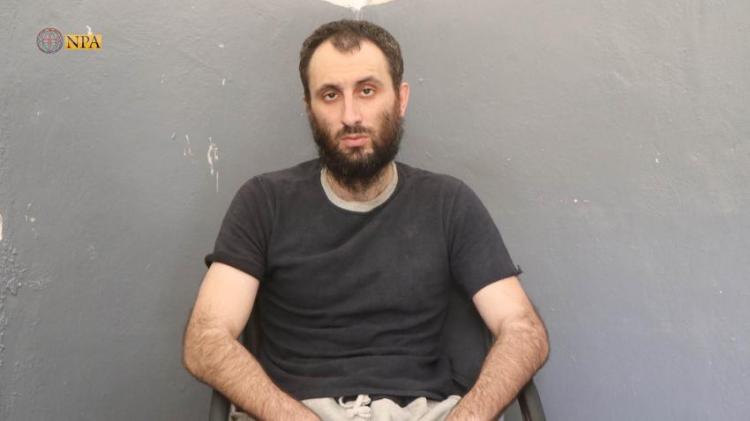
Shqeir, who is an Australian-born jihadist of Syrian descent, and called himself Abu Bakr al-Shami, sits in one of the Syrian Democratic Forces (SDF) detention centers in northeastern Syria, in a single room isolated from the rest of the collective dormitories.
The story of the fourth Australian jihadist who was interviewed by North-Press, had many junctures, the most highlighted was his joining al-Nusra Front, the Syrian branch of al-Qaida, before becoming an interpreter for ISIS with foreign arrivals in Syria and Iraq.
Beginning with al-Qaida
Shqeir’s Jihadi journey began with his joining al-Nusra Front, which was then a Syrian armed opposition group, supported implicitly by Turkey at the time. “There were facilities for crossing the borders”, he said.
Like most immigrant jihadists who joined ISIS and al-Nusra Front, Shqeir was one of the jihadists who entered through Turkey, considering himself as coming to “help the people”.
He remained in the western countryside of Idlib in the hospitability of al-Nusra Front for a while, to participate, later, in the battles of the northern countryside of Aleppo, to make one of the textile factories in Sheikh Najjar industrial city a headquarter, which was controlled by al-Nusra Front.
Motivation
Shqeir linked the reason for joining al-Nusra Front to the great media pumping about the Syrian crisis between 2011 and 2012, saying: “When you go to the mosque, you can see that everyone talks about Syria, when you sit with your friends, they talk about Syria, people everywhere talk about Syria”, ruling out any radical and religious tendencies.
He said: “I wasn’t joining the demonstrations, but I was joining charity feasts”, referring to the charity feasts that were taking place in Australia which encouraged him to come to Syria.
The Jihadist explained that the third factor which pushed him to come to Syria is to support in the war, cosidering that Australia is more beautiful to be left for coming to Syria without strong motives.
The siege of Homs
The Australian jihadist, who was wandering in the Syrian cities as if they were Sydney and Melbourne, he moved later to Homs with his Australian wife, to join the fight with al-Nusra Front in Homs during its siege which was imposed by the Syrian government forces on armed opposition groups’ areas of control, in the city and the countryside.
The siege of Homs was the last station of the jihadist emigrant with al-Nusra Front, where he decided not to surrender to the Syrian government, rather, he moved to Raqqa via smugglers in early 2014.
An old jihadist
Shqeir is considered as a longtime jihadist within ISIS group, he is one of the immigrants who joined the group even before the declaration of the caliphate on June 29, 2014.
His jihadi journey with ISIS wasn’t successful at the beginning, and it wasn’t as easy as his joining to al-Nusra Front, that received him from the Syrian-Turkish borders, “Joining ISIS group isn’t easy, you must have relatives among them,” he said.
Shqeir completes his narrative saying that he joined the group through someone he had introduced to in Raqqa, and he moved to Deir ez-Zor to become a fighter in the group, the thing that he says he didn’t like, according to him, which pushed him out of Deir ez-Zor to become an interpreter in the training camps of immigrant jihadists who were coming to Syria.
“A person like me cannot meet senior leaders”, said Shqeir, adding that he didn’t meet first ranks leaders of the group, saying: “I saw people in the group who weren’t famous. They were leaders in the last ranks like Abu Omar al-Shami and Khattab al-Shami who were leaders of the camps”.
The Yazidi women
During the meeting, the jihadist was speaking in a strong diplomatic language, which indicating his knowledge of the joints of the things within the group, but his fear of any future trial prevents him of speaking frankly. With regard to the massacres committed by the group against the Yazidis in Shengal/Sinjar northern Iraq, he said: “I don’t know what motivated the group to commit massacres against them”.
“We are affiliated with ISIS group, so I think you won’t like what I say”, he says as referring to the fact that he has nothing to do with the group, and that any word he will utter in the interview is tied to the extremist group.
Shqeir goes on to say that if there is an Islamic right in what the group did with the Yazidis, he won’t contradict that, stressing at the same time that thoughout his stay in the lands of the caliphate, and his tournament in the training camps as an “interpreter”, he didn’t met Yazidi women slaves, noting that he was hearing that they were being sold and bought.
Al-Golani and al-Baghdadi states
Shqeir favored ISIS to al-Nusra Front, where he said that he joined al-Nusra Front at the beginning without any information about them, unlike the group of which Shqeir considered its “caliphate” as the main motive for bringing extremist militants and ordinary people, unlike al-Nusra.
Shqeir claimed that he was earning $50 per month, (SYP 25.000), which he considered as a small amount for one person who was living in besieged areas which were being reduced day after day, because of the ongoing shelling, but Shqeir revealed that he brought money with him from Australia and his condition was affordable.
The punishment
Although he admitted that the group was implementing the law of God and that he followed correct things religiously, Shqeir didn’t want to return to the Islamic State group(IS) in case of its return militarily.
“We have experienced difficult things in our lives, I mean hard news, we need to think and wait”, Shqeir said while he was squeezing his hands and his eyes were full of tears.
Unlike other Australian jihadists, Shqeir didn’t ask for lessening his sentence or sending him to Australia, saying: “No matter where I will be imprisoned, here or in Australia, it is a punishment”, pointing out for not knowing how the Australian government will treat with that, which he estimated that it won’t be an easy one.
At the end of his talk, Shqeir revealed that he had recognized the three other jihadists, and that they had met each other in the last few days in the town of al-Baghouz before being imprisoned.
(This meeting is published as part of a file on the Australian jihadists who had fought among the ranks of the Islamic State).