
Al-Liwa library in Qamishli, seven decades of clinging to the land and books
Qamishli – North-Press Agency
Reem Chamoun
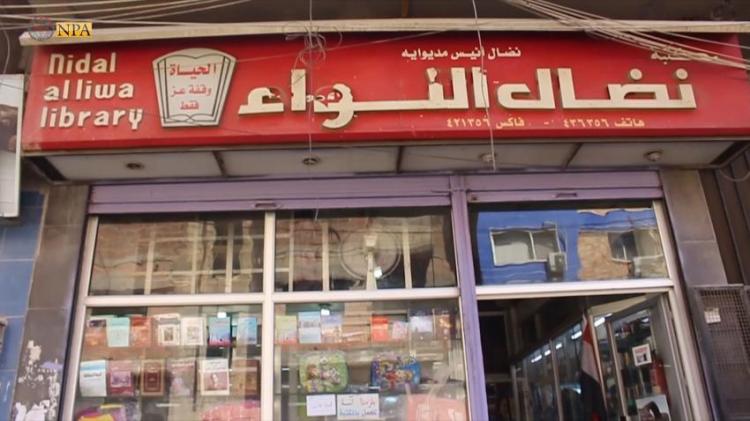
Al-Liwa Library is one of the oldest libraries in the city of Qamishli in northeastern Syria. It was opened in 1946 and was called “Liwa Iskenderun Library” after the birthplace of its owner “Anis Mediwayah”. It was one of the first libraries to print and publish books in the diverse city.
The owner of the library Anis Mediwayah spoke to North-Press about his origins, beginnings and how he had set up the library, “I was born in 1926 in Liwa Iskenderun (Alexandretta, a part of Turkey since 1939). At the age of 13, I fled with my father in 1939 to Aleppo, after the French and Turkey had agreed to make Liwa Iskenderun a Turkish territory, then we moved to the city of Qamishli and settled there as my father was appointed as the director of Quraish School, which was considered as one of the first established public schools in the city”.
Mediwayah explains that at the time, the students who finished primary school were teaching in the same schools, because of the small number of teaching staff at that time, as the school was affiliated with the Directorate of Knowledge (currently Directorate of Education), “I was one of the students who finished primary school in Arabic and French languages,” he said.
Regarding the reasons that led him to establish the library, the owner said: “My father encouraged me in 1946, when I was about 20 years old, to open my own library, as I did so and named it according to my birthplace name, I then changed the name to Nidal Iskenderun (struggle of Iskenderun)”, pointing out that the library is a center for intellectual class, being the first library in the region, while the cultural center of the city of Qamishli was not established until 1959.
“At the library, we were providing the students with complete stationery, as they had to bring it from the Turkish city of Nusaybin at that time, as well as securing books and printing them instead of waiting to be sent from Aleppo, Damascus and Beirut”, describing the library at that stage as a “cultural and scientific point in the city”, Mediwayah added.
Speaking about the cultural movement at that stage, he said: “At that time, the Syrian government issued a decision to grant teachers who work in al-Jazira region an additional of 25 percent of their salary. Many intellectuals and writers from different Syrian cities such as Aleppo, Hama and Damascus came to work in the city as a result, and became permanent library visitors, such as Nadim Marashli, Ali al-Zebaq, Adnan Murad, Mousa Ramadan, Jerjes Nassif and many others”.
Mediwayah explained that those intellectuals were frequently visiting the library, and later they asked for the establishment of a publishing house. Upon their request, more than 20 books were printed for culture lovers in this city, pointing out that the publishing house of Liwa Library is considered to be as the first publishing house in Syria, according to him.
Mediwayah added that he has written many books, such as, “How to place Hamza in the Arabic language” in 1949, and also “The Unknown World of Freemasonry ” in 1954, pointing out that he didn’t put his name on the book, “because Freemasonry was widespread at the time in Syria”.
He explained that there were about 33 Masonic forums in the Syrian cities, 4 of which were in the city of Qamishli, “the situation did not allow me to write my name on this book”.
Regarding other writings for Anis Mediwayah, he said: “In the last ten years I have written and printed a book on the history of al-Qamishli, as the Syrian Information Ministry in Damascus contacted me and asked me to do so”, giving that they had no much information about the city’s history, “It was written in 2008 and printed in 2011”.
It is noteworthy that Anis Mediwayah, is about 93 years old, has maintained his library “Nidal al-Liwaa” since its establishment until today, which is located in the middle of Qamishli market. Although the focus is no longer limited to literary and cultural books, as school tools and stationery are now occupying the largest part. However, he is determined to remain with his library as the foundation stone of the city.