
Amid their fear of return, Iraqi government is ignoring its refugee citizens
Hasakah – North-Press Agency
Delsoz Yousef / Jindar Abdulqader
The Iraqi government is ignoring its citizens who are living in refugee camps in Syria, and does not demand their repatriation, as many of them fear returning after the ongoing sectarian conflicts in their country.
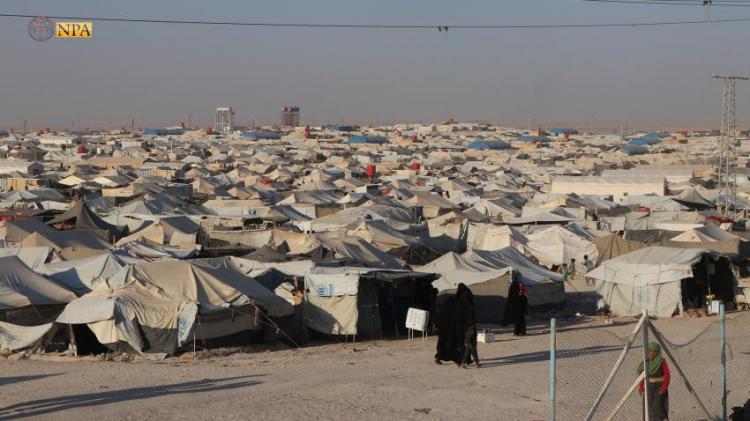
A delegation from the Iraqi Ministry of Immigration, accompanied by the United Nations High Commissioner for Human Rights, has recently visited al-Hawl camp, east of Hasakah city, which includes about 42,000 Iraqi refugees. The mentioned visit aimed at checking on conditions of refugees and coordinating with the Autonomous Administration to send a new batch of refugees to their country.
Fares al-Barghouth, director of the Iraqi Refugee Office in al-Hawl camp told North-Press that “all procedures by the Autonomous Administration side are complete to send a new batch of refugees,” noting that the Iraqi side is the one which obstructs the return process under the pretext of “security checks and the lack of places to house the returnees.”
Al-Barghouth said that during the last three months, Iraqi delegations have visited al-Hawl camp three times. However, those visits “had no results regarding the file of the refugees’ return to their homes, where their statements are limited to scheduling without implementation,” according to al-Barghouth.
He pointed out that the issue of the refugees’ return to Iraq needs guarantees from official bodies. “There is a fear of ongoing sectarian conflicts in the country, especially the Popular Mobilization Forces (al-Hashd ash-Shaʿabi), who arrest the returnees, as a large percentage of the fat of those who had returned is still unknown,” al-Barghouth said.
Split by opinion
Iraqi refugees in al-Hawl camp are divided between supporters for returning to their country, and those who prefer to stay in the camp despite the difficult living conditions, in light of turning a blind eye to their situation by humanitarian organizations.
Ahlam, a refugee from al-Mosul governorate, said that she had registered her family’s name on the return list, but her request was “rejected without knowing the reasons,” where she’s asking the Iraqi government to find solutions to repatriate them home.
Another refugee from Salah ad-Din governorate, a veiled woman who didn’t mentioned her name, said: “We want to go back to Iraq. Sometimes they tell us that there’re no trips to Iraq, while other times they say that the Iraqi government doesn’t want to receive you. We have contacted with our relatives in Iraq and they ask us to come, but current circumstances stand against us.”
On the other hand, many refugees are afraid to return because of their ties with the Islamic State (IS), such as the refugee Maysa (a fake name) who sells ice blocks in the camp market, where her husband and son have been in detention centers of the Syrian Democratic Forces (SDF) since they left the last stronghold of the organization in al-Baghouz, east of Deir ez-Zor.
While others are concerned about the issue of arrest by the Popular Mobilization Forces, who track dawn returnees related or involved in the Islamic State (IS), whose fate is often unknown.
According to the directorate of the Iraqi Refugee Office in al-Hawl camp, the last batch of refugees returned to Iraq was eight months ago, stressing that since the establishment of a refugee office in 2016, about 60 thousands of refugees have been returned to Iraq.