
Kurdish students protest limits on Kurdish language classes in Syria
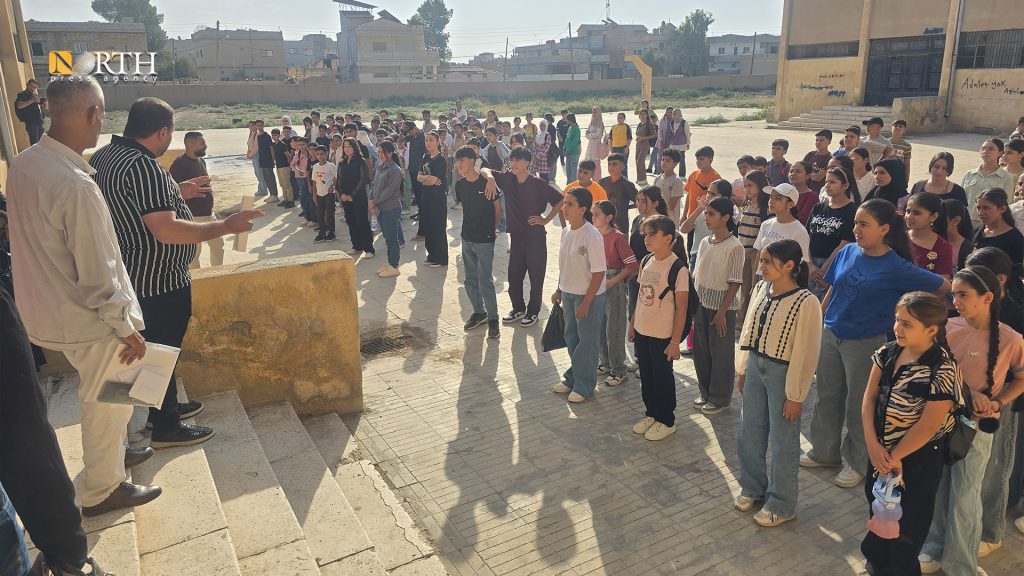
QAMISHLI, Syria (North Press) – Kurdish students in Hasakah, Qamishli and Kobani cities on Sunday refused to enter classrooms as the 2026-2027 academic year began, protesting a Syrian Education Ministry decision limiting Kurdish-language instruction to three classes per week.
Students issued statements rejecting the new regulations and demanding the right to study in their mother tongue, including the use of Kurdish as the main language of instruction.
“The Kurdish language is our voice, our culture and our existence, and we do not accept only three classes for our language,” students said in their statements.
In Hasakah, hundreds of students reportedly refused to enter their schools, while teachers also criticized the decision, saying three weekly classes would not be sufficient to teach Kurdish.
Student Ibrahim Amer said he would not return to school until the issue was resolved.
“Why can’t we learn in Kurdish when it is our mother tongue?” he said.
Teacher Thuraya Darwish noted that students in northeast Syria had studied under a Kurdish-medium education system for more than a decade.
“For 14 years, students were educated based on their mother tongue. How can they now be required to study in Arabic?” She told the Kurdish news agency ANHA.
Similar protests were reported in Kobani, where students rejected the reduction in Kurdish-language instruction and called for Kurdish to remain the main language used in education.
Student Hengavin Moussa said the protesters did not oppose Arabic but wanted their mother tongue to remain central to their education.
The protests follow a major change in Syria’s education system after the integration process in northeast Syria.
In January, Syrian Transitional President Ahmad al-Sharaa issued Decree 13, recognizing Kurdish as a “national language” and allowing it to be taught in public and private schools in areas with significant Kurdish populations.
The Education Ministry later prepared Kurdish-language curricula for the 2026-2027 academic year. However, instructions issued in late August limited Kurdish-language classes to three per week, while allowing several subjects to be taught in Kurdish or Arabic during a transitional period.
The system replaces the Kurdish-medium education introduced by the Kurdish Autonomous Administration in northeast Syria more than a decade ago, prompting renewed Kurdish demands for broader constitutional and educational recognition.