
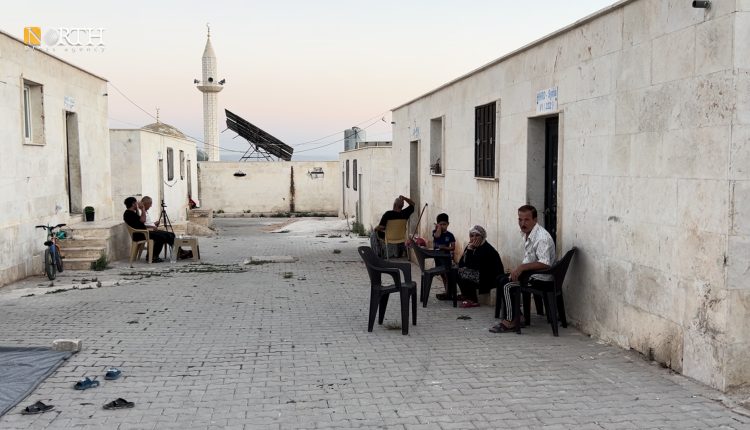
AFRIN, Syria (North Press) – Around 16,000 families have returned to Afrin, northwestern Syria, since the beginning of 2026, but many returnees living in shelter centers continue to face severe shortages of basic services, turning their long-awaited return into a new struggle for survival.
Despite the growing number of returns, residents at the Kafr Rom shelter center in the Sharran district complain of shortages of water, healthcare and other essential services, while concerns are also growing over the need for heating supplies ahead of winter.
Local officials say the increasing number of returnees has exceeded available resources, highlighting the need for additional support to provide basic services and improve living conditions.
Issam Hassan Shaaban, director of the Sharran Office of Social Affairs and Labor, told North Press that the area faces multiple needs, including bread, cash assistance, water, waste collection and heating supplies.
Shaaban said difficult weather conditions are expected in the coming months, making the provision of heating materials a priority for returning families.
Closed clinic adds to struggle for medical care
Zakiya Habash, a returnee from the Tabqa city, told North Press that access to medical care remains one of the most pressing challenges at the shelter center.
She said the lack of healthcare services puts residents at risk, particularly during emergencies.
Habash added that her daughter fell ill several days ago and developed a fever of 38 degrees Celsius, but she was unable to obtain medical assistance because the clinic at the center was closed and had no medical staff.
She indicated that many families rely on irregular seasonal work in orchards to earn a living and cover their daily expenses.
Returnees face lack of services and difficult living conditions
Mustafa Hassan, 65, who returned from Raqqa Governorate, described the conditions facing returnees as difficult, saying many families struggle to access even the most basic services.
Hassan told North Press that the road leading to the area creates additional difficulties during emergencies, while patients face challenges reaching hospitals.
He also noted to a water shortage that forces families to buy water and said some residents have had to sell household furniture to meet their daily needs.
Returnees had hoped their living conditions would improve after returning to Afrin, Hassan said, but the reality has continued to bring significant hardship.
Growing number of returnees poses biggest challenge
Imad al-Ni’ma, director of Social Affairs Office in Afrin, said the Sharran district includes a housing settlement accommodating more than 100 families.
He added that the relevant authorities had provided two-room housing units for each family and ensured access to water.
However, al-Ni’ma told North Press that the main challenge remains the large number of families returning to the area, which has exceeded the current capacity to fully meet their needs.
He pointed out that authorities are continuing to work with partners to provide non-food assistance, cash support and rental allowances for families in need.
The situation of returnees living in shelter centers in Afrin remains closely tied to the ability of local authorities and supporting organizations to expand essential services, as the number of returning families continues to grow and the need for sustainable solutions goes beyond emergency assistance.
Afrin, a predominantly Kurdish region in northwestern Syria, has experienced successive waves of displacement since the outbreak of the Syrian conflict.
In March 2018, Turkish forces and affiliated Syrian armed factions took control of the region during Operation Olive Branch, which targeted the Kurdish-led People’s Protection Units (YPG).
The operation displaced tens of thousands of Afrin residents, many of whom fled to camps and communities in Hasakah Governorate and other parts of northeastern Syria.
Years later, some displaced residents have begun returning to their villages and homes. However, damaged property, limited public services, security concerns and unresolved property rights issues continue to complicate their return.
The returns gained momentum following major political changes in Syria after the fall of the Bashar al-Assad government in December 2024, with Syrian authorities and local administrations launching efforts to facilitate the voluntary return of displaced populations.
Since March, authorities have organized a series of convoys carrying displaced families back to Afrin. The first convoy, comprising around 400 families, departed on March 9, followed by additional groups in April and May as preparations continued for larger-scale returns.