

KOBANI, Syria (North Press) – The department of protection of antiquities in the Euphrates region (administrative division includes the areas of Kobani, Tel Abyad and Raqqa) said all archaeological sites and religious shrines sabotaged and plundered during the Syrian war have yet to be renovated.
A law in the United Nations Educational, Scientific and Cultural Organization (UNESCO) prohibits excavation work during the time of war given renovation and excavation are linked to each other, Ali Suleiman, co-chair of the department of protection of antiquities said.
Over the years of the Syrian war, historical hills in the Euphrates region were sabotaged, excavated and plundered by militants, artifacts traders and by members of the Islamic State (ISIS). The majority of the artifacts looted were smuggled into Turkey, according to Suleiman and residents who are interested in archaeology.
He pointed out that all infringements against the historical sites have been documented in writing and photos.
“Nowadays, excavation and renovation cannot be carried out due to the war,” he added.
Between 2017 and 2022, the department of protection of antiquities in the Euphrates region documented the presence of 69 historical sites, including hills, caves and gravesites. The majority of archaeological sites in the Euphrates region lie along the Euphrates River. The most important of which are Tel Barsib (Hittite Masuwari, modern Tel Ahmar), Bojagh village in Sirin area, Tel Chioukh Foqani, Tel Shuyukh Tahtani, Tel Qomluq and Ja’dat al-Maghara.
Smuggling to Turkey
The Euphrates region like all parts of northeastern Syria has no museum. There is only a warehouse that contains antiquities excavated by foreign missions in the region. The antiquities are potteries and small bronze artifacts from the Bronze Age.
Standing near a Romanian burial, the 45-year-old resident Ahmad Ebo, who worked with an Italian excavation mission, narrated to North Press the violations committed against the majority of the archaeological sites on the eastern bank of the Euphrates River.
Ebo confirmed that the opposition factions (known as the Syrian National Army/ SNA) and the Islamic State (ISIS) used to smuggle archaeological artifacts to Turkey during their time of rule. Both sides used to secretly excavate the area using special equipment to sabotage the mosaics. They plundered Romanian gravesites.
Tel Ahmar, Tel Shuyukh Foqani, Tel Shuyukh Tahtani, Tel Qomluq and Ja’dat al-Maghara were looted the most, according to Ebo.
Infringements
The infringements affected a mosaic panel that is considered among the most important archaeological panels discovered in the town of Shuyukh Tahtani, as traders tried to steal it and smuggle it to Turkey, “however, its large size and the lack of techniques to carry it, prevented this,” according to Ebo.
The man refers to Roman cemeteries in the area near Tel Komluq that were not spared from theft during the years when armed factions and ISIS controlled the area.
Historical cemeteries dating back to the Bronze Age were discovered in Tel Shuyukh Tahtani. A pottery and some bronze artifacts were discovered by the Italian mission which stopped work due to the war.
Ebo said some opposition factions set up a military point in Tel Shuyukh Tahtani.
Later, ISIS came and expelled the opposition factions, built a sand berm, dug walls, did secret excavation work and looted potteries, according to Ebo.
Ahead of the Syrian war, a Belgium mission did excavation work in Tel Ahmar, a French one in excavated Ja’dat al-Maghara, another French/Syrian mission in Tel Abar, and a French mission in Qara Qozaq area. However, all of the missions stopped their work with the onset of the Syrian war.
Destroying religious shrines
ISIS took Bojagh as headquarters since it had a temple within. ISIS dug the temple and used the hole as a prison, but the true reason behind that was to plunder the antiquities.
ISIS looted and smuggled the majority of the archaeological objects and only small potteries were left, co-chair of the Department of the protection of antiquities.
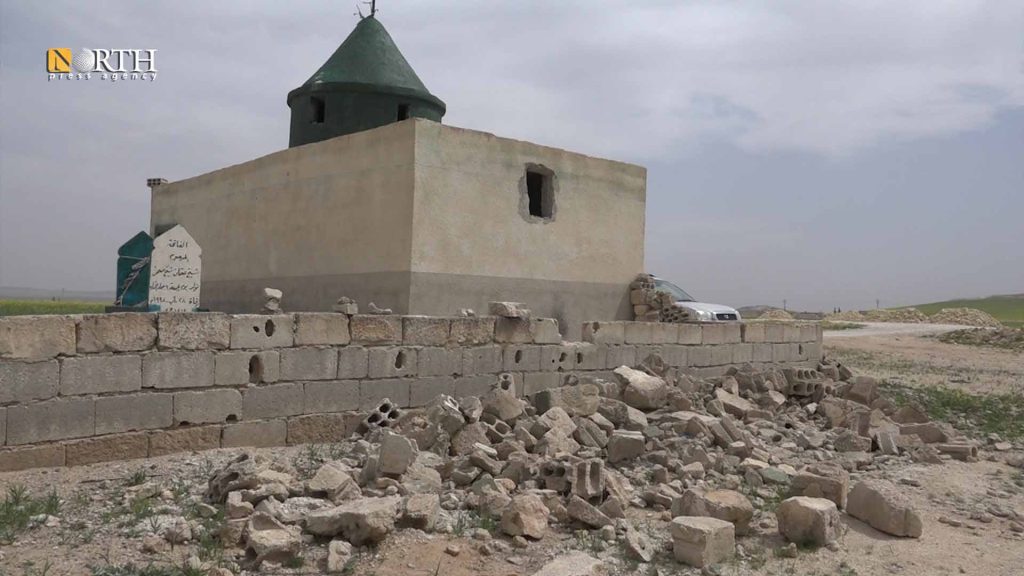
In Sheran village, 8 km east of Kobani, ISIS members detonated the religious shrine known as Sheikh Siroji, dating back to more than 200 years, Sheikho Ali, a 70-year-old resident of Kobani said.
After the defeat of ISIS, the villagers reconstructed the shrine and rebuilt a dome for it.
The historical religious shrines in the area like Sheikh Sahn shrine in the south of Kobani and Sheikh Hassan Haman shrine in Tel Shuyukh Foqani among others were looted and detonated by ISIS.