
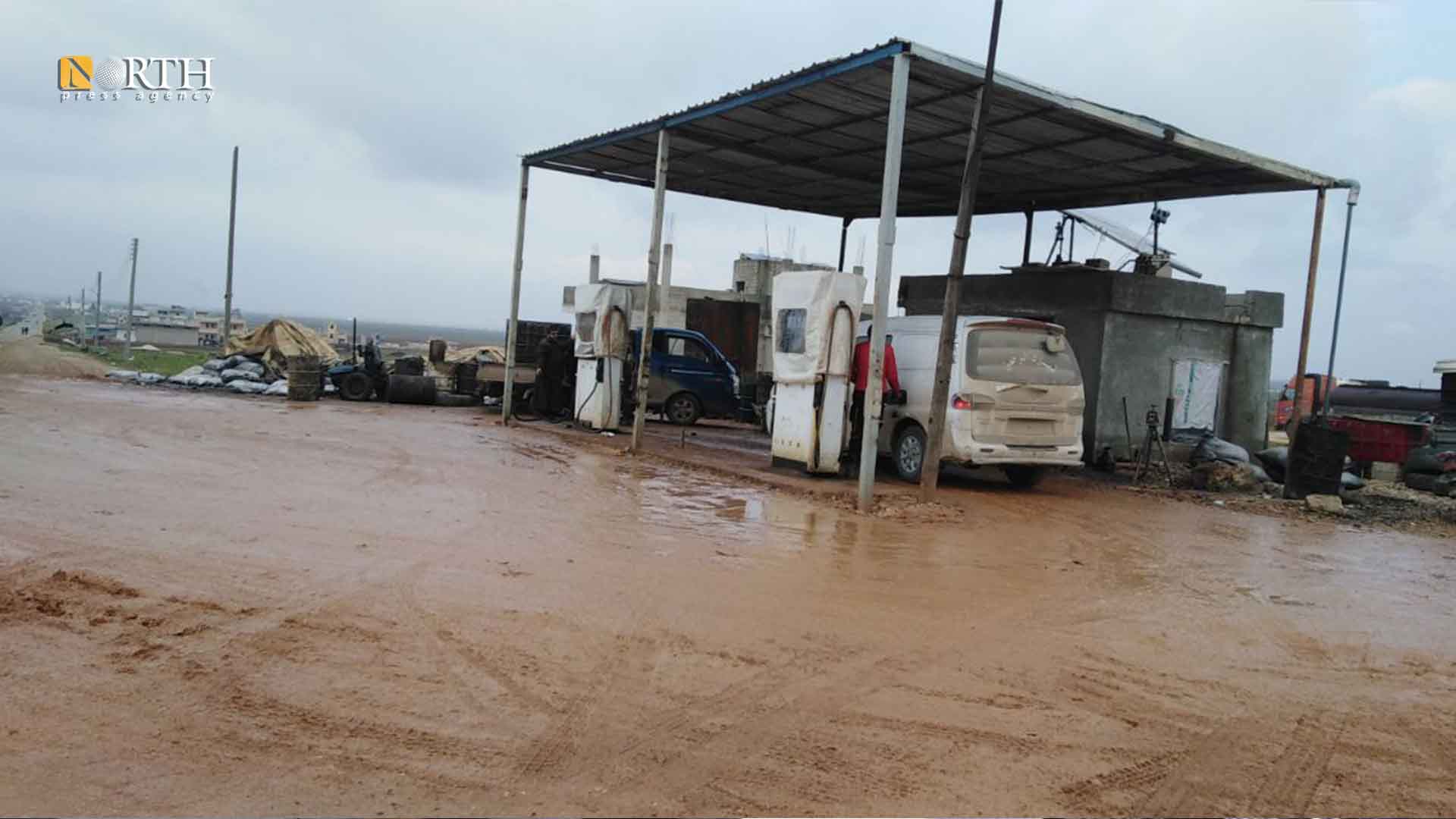
IDLIB, Syria (North Press) – Several days ago, Qadour al-A’raj was released from a prison of Hayat Tahrir al-Sham (HTS, formerly al-Nusra Front) in the town of Atma, northwest Syria, after he was arrested for smuggling fuel from areas in the northern countryside of Aleppo to Idlib.
While inspecting al-A’raj’s car on a checkpoint in north Atma, HTS militants discovered that the fuel tank was full of fuel, so they arrested him, detained him for three days, and seized his car for more than a week.
“I was mistreated by HTS militants at the checkpoint; even I thought I was a criminal or a murderer,” he said.
Many young men from the northern countryside of Idlib smuggle fuel from areas held by Turkish-backed armed groups in north Aleppo to HTS-held areas in Idlib.
These smugglers justify their work and attribute the reason to the big difference in fuel prices, which may reach up to 500 Syrian pounds (SYP) per liter, on top of deteriorating living conditions in light the lack of job opportunities in northern Syria’s camps.
Monopoly
Other smugglers and local residents say that HTS bans fuel smuggling to force people to buy fuel from the Watad Petroleum Company, which was established by the Salvation Government (the civil wing of HTS) and is the sole party responsible for importing fuel from Turkey to Idlib through Bab al-Hawa border crossing. Watad also monopolizes the fuel market in northwestern Syria.
Watad raises fuel prices continuously, and justifies it by citing the high exchange rate of the US dollar against the Turkish lira (TL). Since June 2020, Syrian Salvation Government has used Turkish currency rather than Syrian pounds in all official transactions, which has led to discontent among residents during times of the Turkish lira’s fluctuation.
A few days ago, Watad raised the price of a liter of imported fuel to 6.71 TL (0.77 USD) from 6.42 TL (0.74 USD), while a second type of imported liter of diesel fuel rose to 5.84 TL (0.67 USD) from 5.48 TL (0.63 USD).
The price of a domestic gas bottle increased from 93 to 98 Turkish lira (11.29 USD), while the price of a liter of imported gasoline rose to 7.19 TL (0.83 USD) instead of 6.80 TL (0.78 USD).
The exchange rate of each dollar has reached almost 8.75 Turkish lira, according to the Lira Today website for currency prices.
HTS members inspect travelling cars, opening the fuel tanks and arresting vehicle owners if they find the tanks full of fuel, according to smugglers.
Sometimes, they force the car owners to return to their point of origin to empty the tanks in order to allow them into Idlib.
Smuggling routes
Those smugglers use agricultural routes, which cannot be controlled as a result of trees that block the view, throughout areas linking northern Aleppo and Idlib.
Unlike most young smugglers, 27-year-old IDP Nazih al-Shamali, who is from the northern countryside of Hama and resides in al-Karamah camps north of Idlib, does not hide his work smuggling fuel to Idlib.
Every day, the IDP rides his motorbike heading towards areas in north Aleppo to buy primitively refined fuel at 3.35 TL for each liter to sell at 4.55 TL in the town of Atma.
Although smugglers know that their work is illegal and sometimes dangerous, they cannot manage to find convincing justifications for HTS’ ban on fuel smuggling.
HTS, through banning fuel smuggling from areas outside their areas of control, prevents a reduction in the profit margin they make by controlling the oil market.
Abdulrahman al-Youssef, a tanker owner for distributing water in Atma, needs more than 150 liters of diesel per month.
“If I buy diesel from Idlib, I will pay 150 TL and maybe more than that in northern Aleppo, and this is the reason that pushed me to smuggle fuel from the northern Aleppo countryside to Idlib through agriculture routes” al-Youssef said.