
500 families in Syria’s Sarin get no drinking water
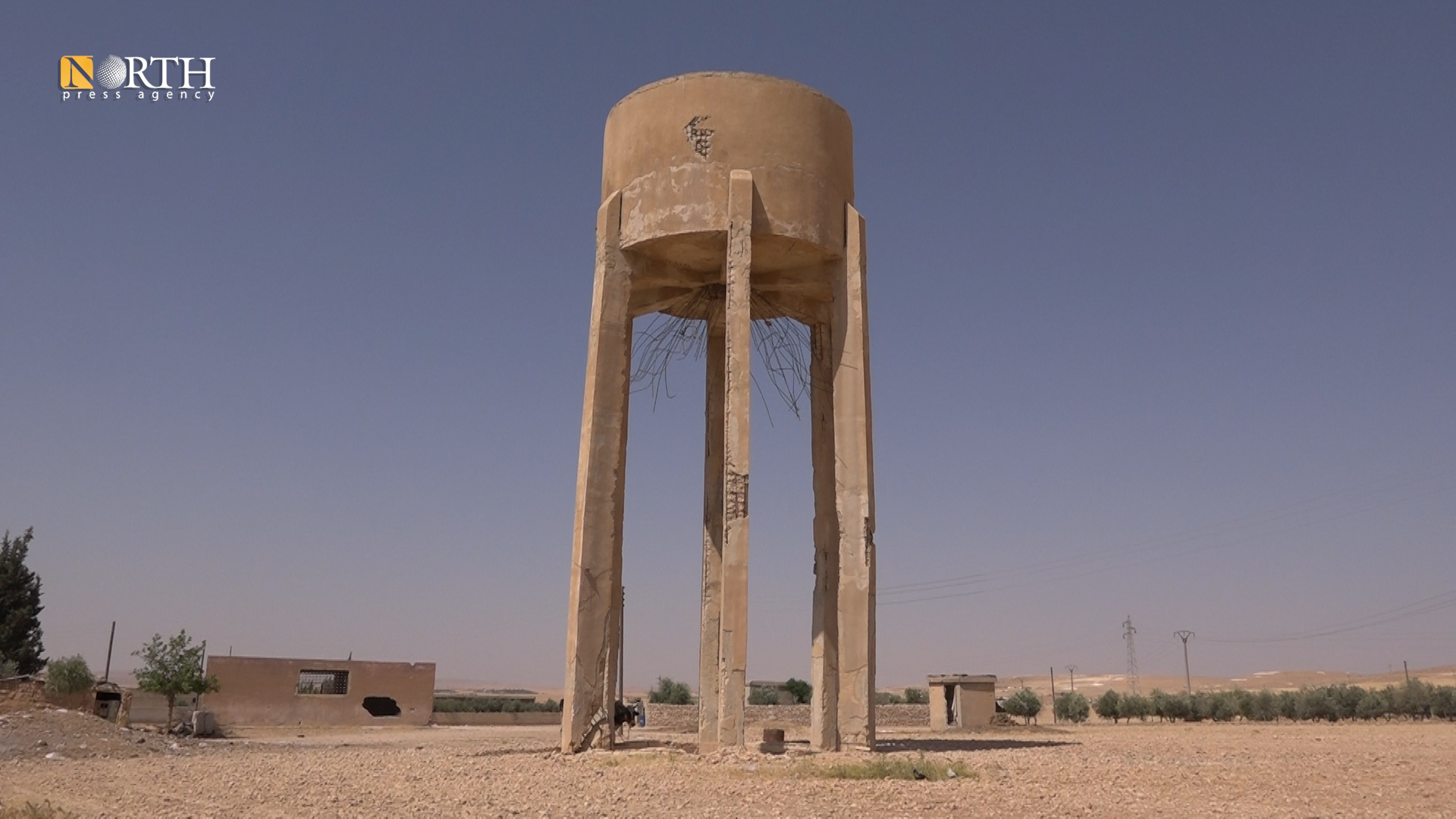
KOBANI, Syria (North Press) – Khalid al-Issa (32 years old), a resident of the town of Sarin in the Kobani countryside, north Syria, has to buy water from tankers in order to get safe drinking water in Srin Qibli neighborhood in the south of the town, due to the lack of water in his neighborhood located on a hill.
About 500 families live in Sarin Qibli neighborhood, who depend on buying drinking water from tanks (the capacity of 15 barrels) at about 8,000 Syrian pounds every four days in the summer, after the tank of the neighborhood was destroyed during the ISIS control of the area.
Before 2015, the neighborhoods of Sarin and its countryside were provided with three water tanks, two of them in the northern and southern neighborhoods and one in the village of Melha, 8 km south of the town near the Euphrates River.
They don’t get water from the Water Institution, and if it is pumped, it is weak and not enough during the summer, al-Issa told North Press.
“Well water is undrinkable, and residents can’t afford to dig new wells because they cost a lot of money,” he added.
The cost of drilling surface wells in the town of Sarin and its surroundings is about one million Syrian pounds, and the water is insufficient, while underground wells cost about five million Syrian pounds due to the nature of its harsh and resistant land to drilling, and the water is not suitable for drinking because it is sulfur-calcareous, according to the owners of drillers in the area.
Al-Issa and residents of the neighborhood submitted several complaints to the Sarin Water Institution, but Water Directorate officials responded that the directorate does not have much potential to implement projects that provide the residents’ need of water, as al-Issa said.
Melha village tank contains 400 cubic meters of water to provide 11 villages in addition to the town, which makes the town’s neighborhoods need to pump water directly from the river to the water network without going through reservoirs.
Ibrahim al-Hammad, 61, a resident of the neighborhood, said that the cause of the problem dates back to more than four years, since they returned after displacement to their town, as a result of the bombing of the neighborhood’s water tank by ISIS militants in the middle of the year 2015.
In 2015, the two reservoirs of the northern and southern neighborhoods were destroyed by explosions carried out by ISIS militants, forcing the Water Directorate to draw water through pumps directly from the Euphrates River, which made it difficult for water to reach the southern neighborhood after passing through the northern neighborhood, the center of the town.
It is clear that olive trees and fruits inside al-Hammad’s house are thirsty. He said that he has to buy water from tankers because the quantities of water that come from the tap are very few, “about ten liters within two hours.”
The man believes that the solution to the water problem in Srin Qibli neighborhood is to lay new water network lines from the water tank in the village of Malha, south of Sarin, without relying on the network of the northern neighborhood connected directly from the Euphrates River through pumps.
Muhammad Khair Dergham, an official at the Water Establishment in the town of Sarin, said that one of the reasons for the lack of water to Srin Qibli neighborhood is the low of water level in the Euphrates River, which caused the suspension of one of the pumps.
The area of Sarin town is large compared to the number of houses in it, and the distance between the city center and Sarin Qibli neighborhood is more than one kilometer, so the pumping force and water pressure decrease due to the distance and the height of the neighborhood compared to the city center, which made it difficult for water to reach it in the required way, according to Dergham.
Dergham added that the Institution submitted a proposal to the General Administration of the Water Directorate in Kobani to work on a project to draw a 3 km water line from Malha village reservoir to Srin Qibli.
He said that they had received promises to start implementing the project during the current year.
The neighborhood’s water needs are filled in winter by 90 percent, while it does not exceed 15 percent during summer, according to the Water Corporation.
Dergham said that the Institution will soon install two new pumps with a capacity of 150 cubic meters for each pump, in addition to installing a new transformer to operate the pumping station, and operate submersibles at the station due to the low of water level.