
Varying food prices in Syria’s Suwayda markets amid “corrupt” supply controls
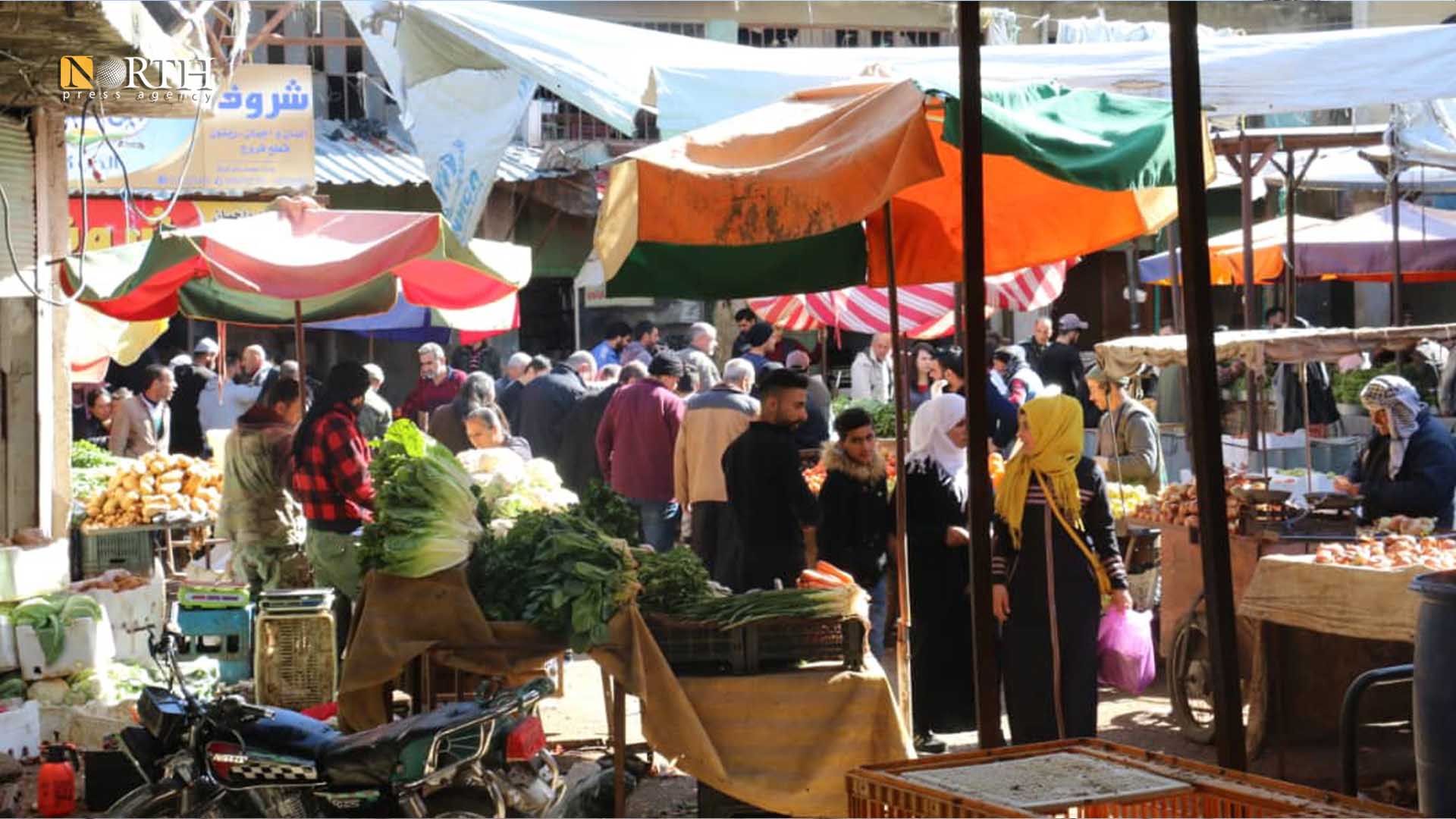
SUWAYDA, Syria (North Press) – The prices of commodities and foodstuffs are floundering in the markets of Suwayda, southern Syria, amid large discrepancy in the pricing of goods between commercial stores, and corruption affecting the government supply control committees and their covering of many wholesalers in Suwayda, in exchange for financial bribes they receive during their tours to the markets.
On April 12, the Legislative Decree No. 8 of 2021 was issued, which includes the new consumer protection law, and the financial fines contained therein amounted to 10 million Syrian pounds, depending on the nature of the violation, in addition to imprisonment.
Absence of government role
“There is no government supply control in the markets of Suwayda, no consumer protection, and the law is totally absent to hold the traders accountable,” Yasser al-Mansi, a pseudonym for a resident of Suwayda, told North Press.
“The supply control committees exist only in the markets to receive financial bribes from shop owners, so that they do not fine them,” he added.
As a result of the absence of the government role in Suwayda and the corruption of its regulatory agencies, traders took advantage of the decision to raise prices and blackmail the defeated population, despite the weakness of the purchase movement and the significant increase in the percentage of people with limited income, according to al-Mansi.
“The prices of commodities in the markets, especially food, have not decreased, despite the recent decline in the exchange rate of the US dollar,” he added.
The prices of some food commodities have decreased, but the matter cannot be clearly reflected on the consumer, because the stability of exchange rates requires a long time to pass, according to Mustafa Jbeil, a pseudonym for a wholesaler in the market of Suwayda.
Chaos and different prices
“There is chaos and price differences between one store and another in all the markets of Suwayda, especially food and detergents,” Samir Al-Harith, a pseudonym for an employee of the government Supply Directorate in Suwayda, told North Press.
Al-Harith justified the prices frenzy in the markets by the “big boom” that occurred as a result of the collapse of the value of the Syrian pound against the US dollar in the last period, in addition to the monopoly of some materials and goods by the traders inside their warehouses.
He believed that the supply control committees are insufficient in the process of controlling prices in Suwayda markets, “It needs the cooperation of the local community, the Suwayda Chamber of Commerce and the societal communities with government agencies to deter traders from manipulating prices,” but without indicating the mechanism of cooperation and ways to implement it.
The decrees issued by the Syrian government in determining and controlling prices within the markets and holding the manipulators accountable remain, “just ink on paper, and they have no value in the midst of corruption in the directorates of supply and consumer protection in Suwayda,” according to Ahmad Ra’ouf, a pseudonym for a member of the Chamber of Commerce.