
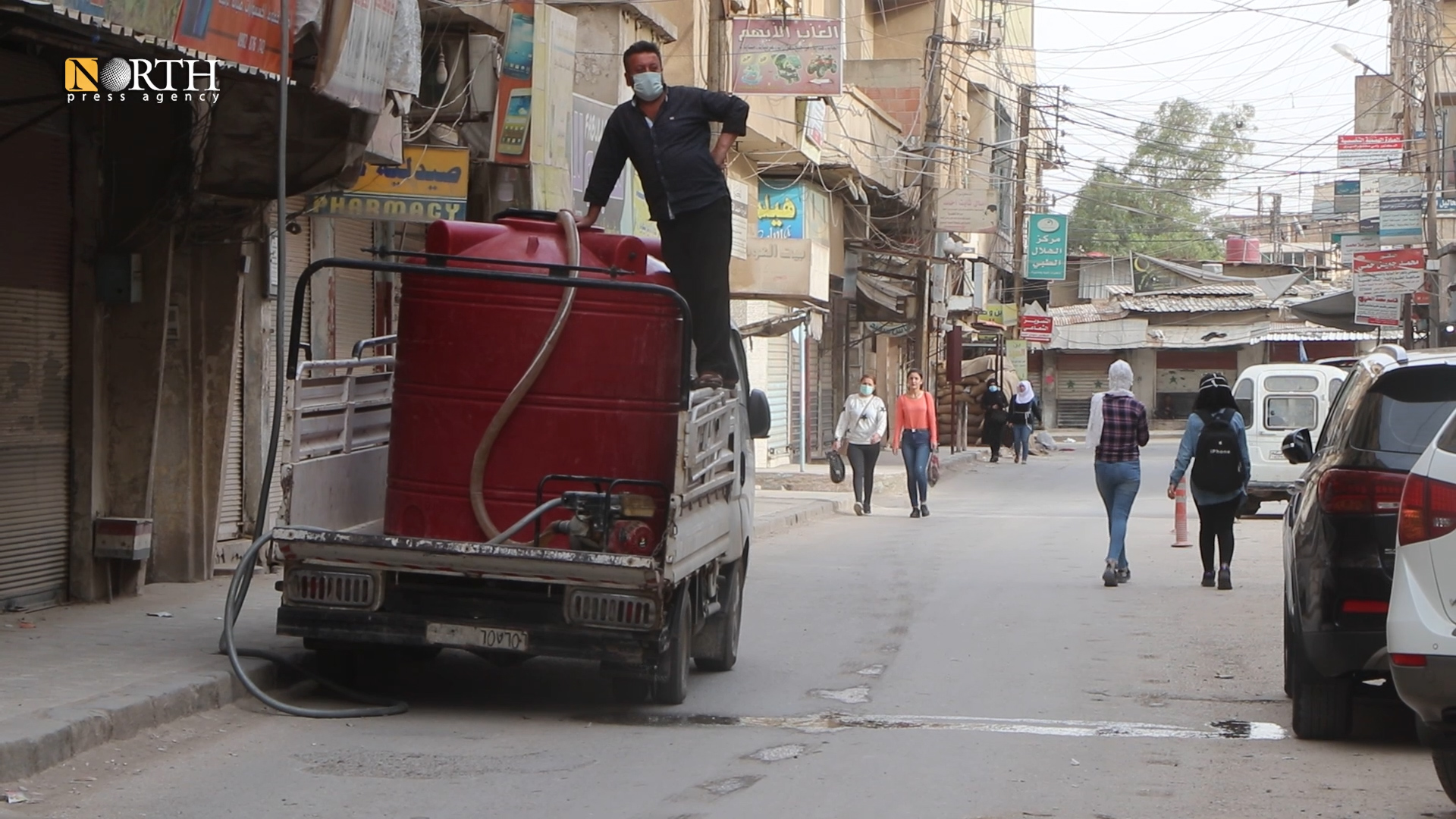
HASAKAH, Syria (North Press) – Residents of the city of Hasakah and its countryside, northeastern Syria, have been suffering for ten days from the interruption of drinking water as a result of Alouk water station in the Sere Kaniye countryside being out of service.
On April 12, a fire broke out at the electricity transmission station in Derbasiya city, northeastern Syria, the station that supplies electricity to the Alouk water station.
The fire resulted in the cutting of power supply to rural lines and causing Alouk water station to be out of service, according to a source from the Electricity Transfer Station in Derbasiya.
The source told North Press at the time that the fire broke out due to the explosion of the main breaker in the transformer, without specifying the period for which maintenance work will end at the station and re-feeding, and linking that to the result of assessing faults and parts available at the station.
The Alouk water station is the main source of drinking water for the cities of Tel Tamr, Hasakah, Shaddadi, and Hawl, its countryside and its affiliated camps.
Meanwhile, residents of Hasakah are forced to use salty and bitter water from the wells they have dug in the neighborhoods during the past year as a result of Turkey’s repeated cutoffs of water.
Meanwhile, residents depend on buying drinking water from tankers at high prices, which increases their suffering in light of the difficult economic conditions that they suffer from.
Muhammad Salem, a resident of Khasman neighborhood of Hasakah city, said that they pay 1,000 Syrian pounds (SYP) for one barrel of water.
Before Alouk station was out of service, the water did not reach the homes due to its poor pumping power, according to the city’s residents, who indicated that their suffering was getting worse in light of the outbreak of the coronavirus in the region and the approaching summer season.
On Wednesday, the city of Hasakah recorded 42 new infections and two deaths from the new coronavirus, according to the Health Board of the Autonomous Administration of North and East Syria (AANES).
With the beginning of 2021, the Autonomous Administration began implementing the works of the Euphrates River water extraction project from the city of Sour in the eastern countryside of Deir ez-Zor to the city of Hasakah and its southern countryside.
But Luqman Musa, the director of the pipeline maintenance project, said in a previous statement to North Press that the project is not considered a substitute for the Alouk water station, but rather an emergency case to secure a certain percentage estimated at 20-25% of Hasakah’s water needs.
The project is scheduled to be completed within three months, with a financial value of one and a half million dollars, according to a previous statement by the Autonomous Administration.
Abdulrahim Muhammad, a resident of Hasakah, said that before it was completely cut off, water was pumped every four days, but the lack of pumping and its short periods lead to the inability of many residents to fill their tanks with water.
He pointed out that the water situation in Hasakah is worsening day after day.
Muhammad Ayoub, a resident of al-Salihiya neighborhood in Hasakah city, said that buying water is an extra burden, added to bread, electricity and other necessities.
He pointed out that most of the time they are forced to stay awake until dawn, hoping to fill the tanks with water, but all in vain. At that time, there is no electricity or generators, and they remain without water.