
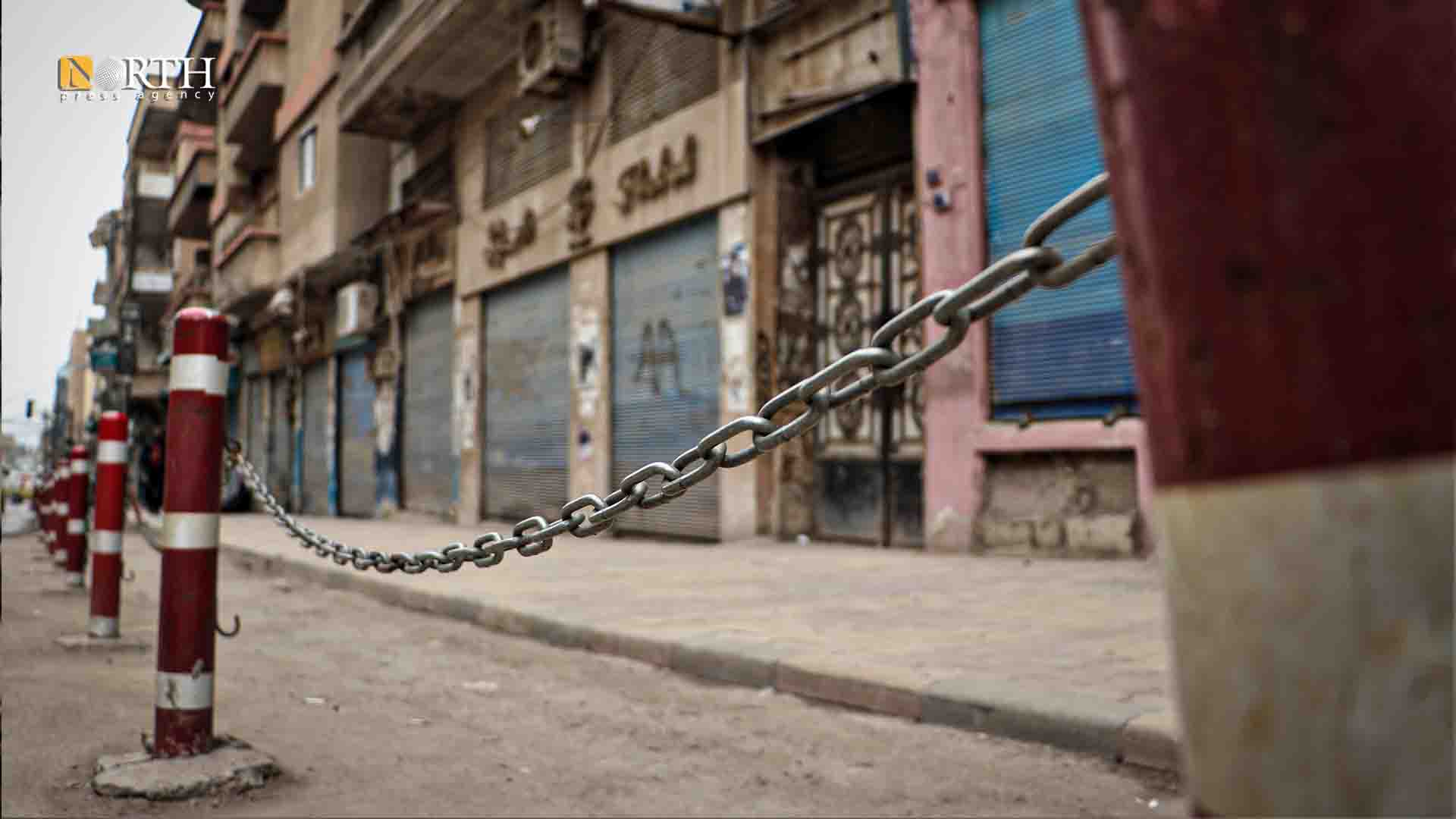
QAMISHLI, Syria (North Press) – Residents and shopkeepers who were included within the lockdown decision in the city of Qamishli, northeast Syria, say that this decision contributes to worsening their economic conditions, as most of them rely on daily incomes to sustain them.
On April 3, the Autonomous Administration in North and East Syria (AANES) decided to impose a complete lockdown on the cities of Qamishli, Hasakah, Raqqa, and Deir ez-Zor due to the increasing number of coronavirus infections in them, accompanied by another partial one in other areas of northeast Syria.
On Tuesday, the decision came into force, and included the lockdown of markets, places of worship, parks, restaurants, cafes, wedding venues, gyms, crossings, universities, institutions, and schools, and it was scheduled to end tomorrow, Monday.
The AANES’s Health Board later announced the imposition of a complete lockdown on the Euphrates region, which started on last Friday.
Paralyzed business
Muhammad Ahmed, a construction worker in Qamishli, said, ”the job movement was weak before the lockdown, and the imposition of the lockdown completely paralyzed the movement.”
”This situation is very hard for those of limited incomes like us, who depend on daily wages especially as we are heading to the month of Ramadan,” he added.
”The government that imposes a lockdown should bear responsibility and secure basic needs for its citizens and compensate the affected ones by this decision,” he pointed out.
On Saturday, the Health Board recorded 169 new coronavirus infections and four deaths in the areas of northeast Syria.
With the new infections, the number of confirmed coronavirus cases in AANES areas has reached 11,938, including 419 deaths and 1,360 recoveries.
During the past period, the areas of AANES have been witnessing a remarkable increase in the number of coronavirus deaths and infections, which threaten to escalate and turn the region into an epicenter of the epidemic.
It is possible to extend the lockdown in AANES regions in light of the failure to control the number of infections, according to member of Crisis Management Team in Jazira region, Afram Ishaq.
Saud al-Awasi, a mobile phone shopkeeper in Qamishli, said that the closure has affected them greatly, especially as his shop is his only source of income.
”Our job was good before the lockdown, as we were receiving money, but now the movement has stopped,” he added.
Al-Awasi criticized the mechanism for implementing the complete lockdown, adding, ”we notice the movement of cars remained as it was, and many do not adhere to the lockdown and the wearing of masks while businesses are stopped.”
He suggested that the AANES impose a complete lockdown that includes all sectors and in return work to secure the residents’ needs or to ”revoke the decision in the first place.”
Real risks
Wholesaler Muhammad Salih Muhammad said that the purchasing movement was not affected by the lockdown decision, and with Ramadan approaching; the demand for food has increased.
“This causes shopkeepers and workers to crowd in front of our shop, and this increases the chances of spreading the virus more and more,” he added.
On Saturday, Ishaq told North Press that the Crisis Management Team will decide whether to extend the lockdown or left it after the meeting on Sunday.
The partial curfew will continue until there is a decrease in infections, in addition to tightening the measures and the complete lockdown in the regions with increasing number of infections, according to Ishaq.
The number of critical cases has not decreased in the hospitals of Raqqa, Hasakah, and Qamishli, despite the imposition of a complete lockdown, according to the Kurdish Red Crescent.