
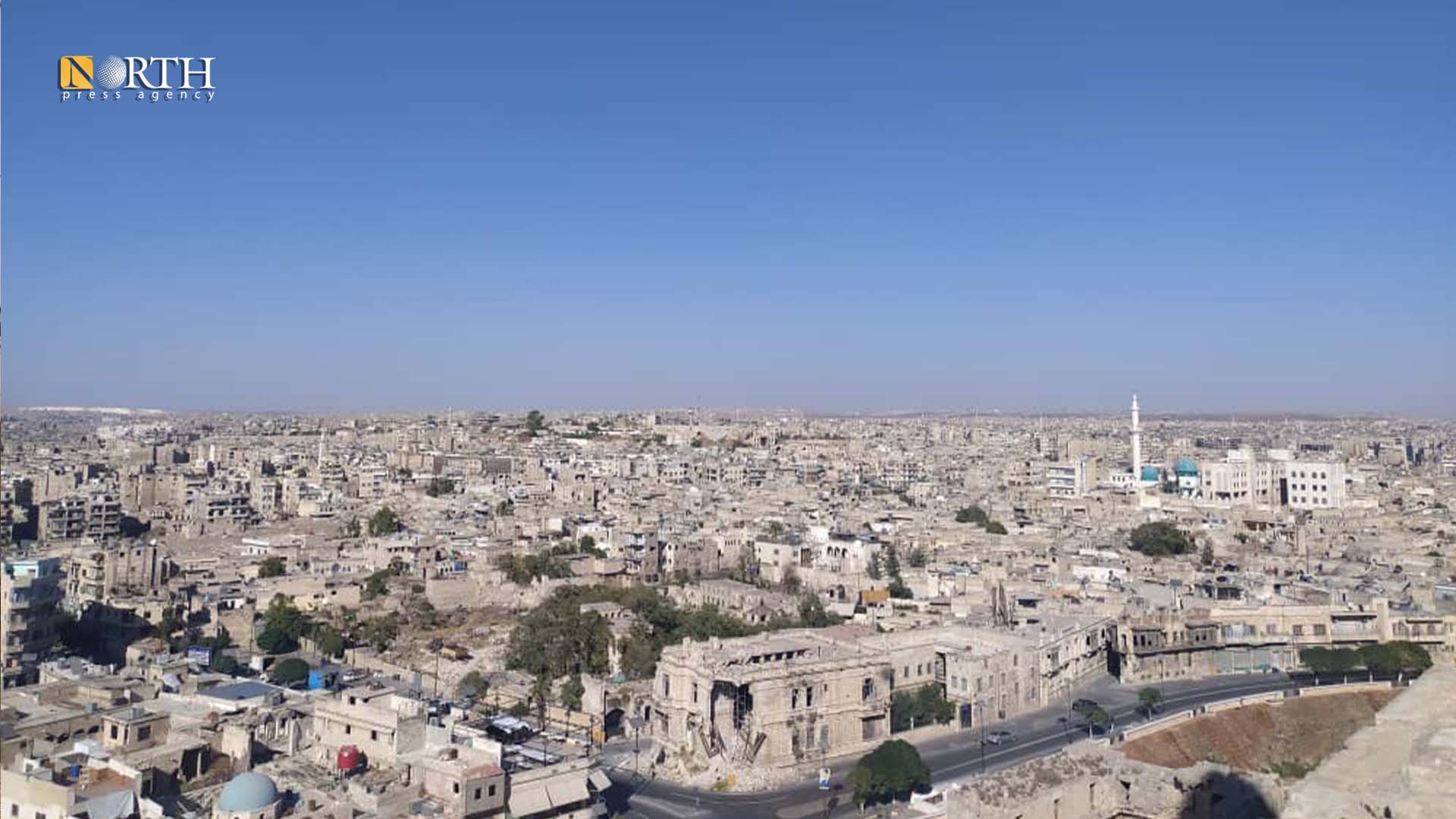
ALEPPO, Syria (North Press) – Residents in the city of Aleppo, northwest Syria, say that the deteriorating economic conditions and the worsening of the living situation are prompting those who did not leave the country, to think and plan to travel outside the country, in light of the government’s inability to find effective solutions to the worsening crises.
Syrian government-held areas are witnessing sever crises, including a shortage of fuel and bread, severe rationing of electricity, in addition to transportation crisis, in light of an unprecedented wave of high prices due to the collapse of the value of the Syrian pound.
Insufficient income
Dirar Zain al-Din, 36, who owns a car-body repair workshop in al-Mashhad neighborhood in Aleppo, said that he works 12 hours in his workshop, “but what I earn is not enough to pay the rent for my house and the workshop, and buy basic needs for my family.”
The monthly earning of Zain al-Din’s workshop does not exceed 400,000 SYP, of which he pays 75,000 SYP as a rent for his house and 50,000 for the workshop rent, “I only have 275,000 SYP left.”
He believes that if his workshop were in a country other than Syria, his situation would be much better. He cites the circumstances of his relatives and colleagues who left the country at the beginning of the war, “they are now enjoying living conditions that are a dream for us.”
He is seriously thinking about immigration, “whatever the conditions in the country I will go to, it will remain better than our miserable conditions that we live every day.”
The number of Syrian refugees abroad exceeds six million people spread over 126 countries, according to a report issued by the United Nations High Commissioner for Refugees (UNHCR) in 2019.
Price of staying in the country
On November 11, 2020, a “Refugee Conference” was held in Damascus, which Russia called to discuss the return of the Syrian refugees in the neighboring countries to their homes.
However, the Syrians, both at home and abroad, addressed the conference with great irony and sarcasm, and demanded holding a conference to get those who remained, out of the country.
Ismail al-Sawaf, 38, a graduate of an industrial institute who finished his reserve duty a year ago, said that he had spent more than seven years of his life within the ranks of the government forces.
“During those years, I could not achieve any progress on the financial and living levels,” he added.
“All that I have achieved is promises of a government job because I have finished the military service, but this job is for a wage that does not exceed 50,000 SYP.”
Al-Sawaf is thinking about selling the house that he owns, to secure travel expenses. He considers that “those remained in Syria have presented their lives, ages and money as a price without obtaining any result.”
Al-Sawaf expressed his dissatisfaction with the continued queues of residents in front of the bakeries, gas stations and bus stations, “we stand in line for a piece of bread or we hope for a message to give us a little sugar and a handful of rice.”
Early in 2019, the Syrian government launched the smart card project, through which the residents can obtain allowances that residents describe as “scarce”, from heating oil, domestic gas, bread, and various supplies of sugar, rice, and others.
Government tightening
Muhammad Nur al-Sabbagh, owner of a real estate office in al-Akramiyah neighborhood in Aleppo, said that government policies were “the biggest reason for the migration of many families from Aleppo, and they will contribute to the emigration of more.”
He added that the government continues tightening through the laws and regulations it issues from time to time that restrict the movement of work.
“Owners of commercial and industrial businesses are now afraid of the security forces and customs interference in their business under the pretext of smuggled goods, violating regulations, or dealing in other than the Syrian pound.”
Al-Sabbagh seeks to emigrate abroad because “whoever violates or opposes, becomes a prisoner of the security services.”