
Hasakah – North-Press Agency
Delsoz Youssef
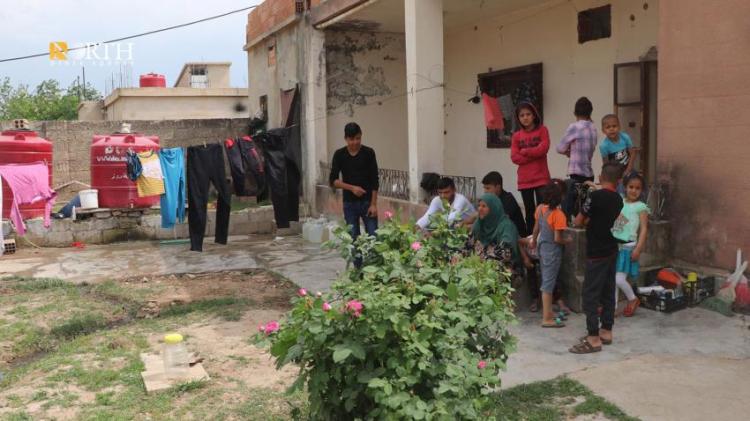
Thousands of displaced people from Sere-Kaniye (Ras al-Ain) residing in the town of Tal Tamr, 40 km northwest of Hasakah, suffer from difficult humanitarian and living conditions as a result of the absence of aid provided by humanitarian organizations in the region, as well as the continuation of unemployment among them after losing their jobs due to the takeover of their regions by the Turkish army and its affiliated armed opposition groups in November 2019.
According to the statistics of the local council of Tal-Tamr, about 3,000 families consisting of about 30,000 people, most of whom are women and children from the Turkish-army controlled Sere-Kaniye (Ras al-Ain) region and the northern countryside of Tal-Tamr, are distributed in 12 villages west of the town and schools that were turned into shelters when they lost their livelihoods after fleeing their areas.
Bad living situations
Abdulqader Ahmad, who has been displaced from Sere-Kaniye (Ras al-Ain) for six months and lives in the village of Tal-Nasri, 1 km south of Tal-Tamr, said that the living conditions of the displaced families are very poor amid the absence of the role of the humanitarian organizations, and that “no organization has provided us any aid for nearly two months.”
Ahmad used to work in carpentry before, but now he is unemployed, and there is no reliable income for his needs. “Before the Turkish attacks on Sere-Kaniye (Ras al-Ain), job opportunities were good, but now I am without work, especially because now we are under a curfew to prevent a coronavirus outbreak.”
Amina Muhammad’s situation is no different from her neighbor Abdulqader. She supports her children after the death of her husband years ago, and her young daughter suffers from seizures after she was injured by shrapnel from Turkish army shell which targeted the city of Sere-Kaniye (Ras al-Ain) in October last year.
“We are experiencing difficulties in living due to unemployment and the lack of aid from NGOs. Previously, the aid was reaching us, but it was cut off more than two months ago,” she said.
“My daughter was injured by shrapnel to her leg in Sere-Kaniye (Ras al-Ain), and Tal-Tamr hospital provided us assistance at the time, but now she is suffering from seizures due to the lack of health care, and our living situation does not allow us to follow up her situation and take her to the doctors for treatment as required," she added.
Absent organizations
The Office of Organizations Affairs in the Autonomous Administration, which supervises the affairs of IDPs in Tal-Tamr area, believes that the IDPs depend primarily on humanitarian aid in light of the high cost of the daily necessities, and that they need help at least once a week in order to meet their needs. However, the absence of the organizations' roles exacerbates the difficulty of their living situation in light of the curfew announced more than a month ago to confront coronavirus.
Khalil Khllo, an official in the Office of Organizations Affairs in Tal Tamr, told North Press that about 30,000 IDPs from Sere-Kaniye and its countryside live in the town of Tal Tamr and the surrounding villages.
“These IDPs are going through difficult living conditions as a result of the lack of assistance provided to them by humanitarian organizations, especially since the majority of them are of low-income families,” he said.
“We are in constant contact with the organizations working in the region to pressure them to provide aid, as we see the deteriorating living conditions that these IDPs are suffering from, but the assistance has not been provided as required so far, especially since the majority of them depend, to a large extent, on the relief assistance provided to them as a result of unemployment,” he added.
On March 15, the Office of Organizations Affairs in the Autonomous Administration of North and East Syria decided to suspend all activities of local and international organizations related to training, rehabilitation workshops, and closed meetings.
The Office of Organizations Affairs excluded humanitarian organizations from the decision to distribute food and relief baskets.