
Raqqa – North-Press Agency
Mustafa al-Khalil – Ahmad al-Hassan
Upon the precautionary measures against the spread of coronavirus in the areas of the Autonomous Administration of North and East Syria, that started on the 23rd of last March, those with limited income are facing difficulty in managing the costs of daily life, especially those who work with daily wages.
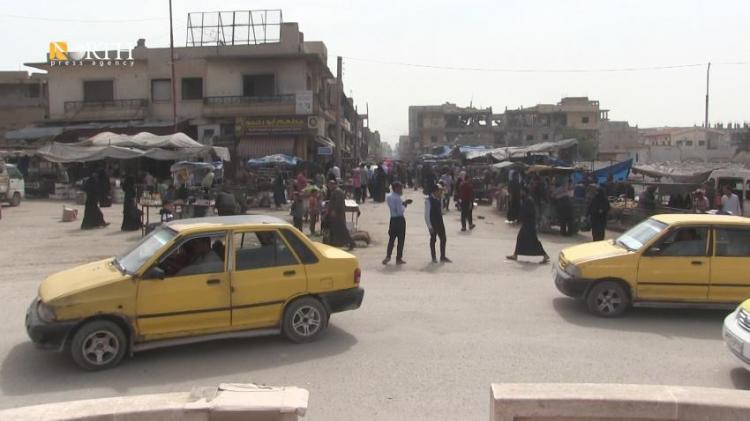
In the northern Syrian city of Raqqa, residents of low-income complain of the difficulty of securing the requirements of their families, especially, after the decision to extend the lockdown early this week.
Issa al-Aswad, 47, a resident of the city of Raqqa, who works in professional services, says that the extension of the lockdown "will reflect negatively on me as I suffer from poor material conditions," because he provides for a family of five children with special needs in addition to their mother.
Since the lockdown took effect in the region, al-Aswad is no longer able to find work until today, which has resulted in debts in exchange for the daily needs he buys from the food stores in the al-Jamea al-Atiq neighborhood in the city center of Raqqa.
Besides, al-Aswad lives in a rented house and pays 20,000 Syrian pounds per month, beside electricity bills that weigh on his shoulders.
Ammar al-Khalaf, 26, an employee in the Internal Transportation Department in the al-Shaab Municipality in Raqqa, said: "The decision to ban the movement is a double-edged weapon, as it helps the prevention of the spread of coronavirus, the thing that great countries in the world were unable to tackle. The decision also has a negative side, it is harming those with limited incomes and workers because they are unable to continue their work as it was before the lockdown."
The city's markets witnessed an unprecedented rise in the prices of food and vegetables, in conjunction with the imposed lockdown's entry into force, which caused a wave of discontent among residents who accused traders of exploiting the status quo.
Nevertheless, some demand an extension of the lockdown once again, as Muhammad al-Abdullah, 27, a resident of the city, demanded that due to "the presence of infections in countries neighboring northeastern Syria," he said.
Earlier this month, the office of organizations affiliated with the Social Affairs and Labor Committee in Raqqa's Civil Council, began cooperating with some local organizations to distribute "emergency" food baskets, according to the decision issued by the Autonomous Administration in March 29th, which stood for the distribution of food aid to "needy" families in the cities and towns of northeastern Syria.