
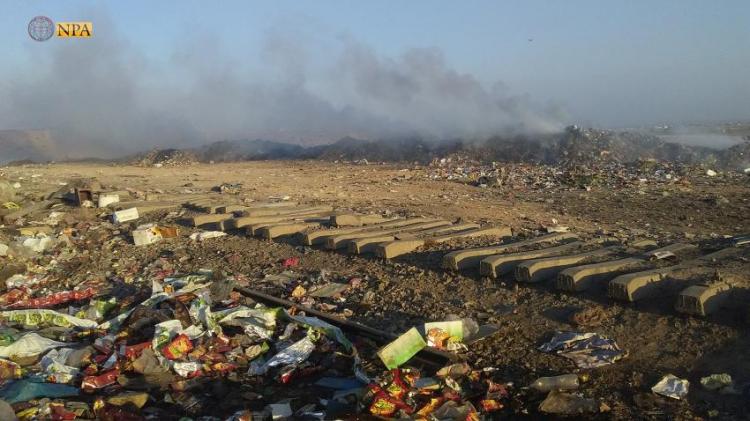
Falluja neighborhood in Raqqa oversees a main landfill
Raqqa- North-Press Agency
Mustafa al-Khalil
The residents of Fallujah neighborhood in the city of Raqqa, northeastern Syria, suffer the spread of flies and the release of unpleasant odors throughout the neighborhood, as the city’s main landfill located there, in addition to suffering from the lack of a sewage networks and the unavailability of drinking water.
This neighborhood is located in northeastern Raqqa, about 4km far from its center, as it’s considered to be one of the slums neighborhoods of the city which includes about 313 families.
Prevalence of diseases and lack of services
“There are 10 cases of leishmaniasis in the neighborhood which caused by flies coming from the randomly spread of waste and garbage throughout the neighborhood”, said Ahmad al-Jalout, a resident in the neighborhood.
For his part, Eid al-Wawi, another resident of Falluja neighborhood told North-Press that they suffer the absence of drinking water which obliges them to buy it from reservoirs that roam the neighborhood during the day hours, noting that the water they buy “causes diarrhea and intestinal infections, especially to children”.
The residents of the neighborhood have demanded the municipality and the Civil Council of Raqqa, to fill the roads and remove random dumping sites, and asked for the construction of a dispensary, and providing internal transport buses like the rest of the neighborhoods of Raqqa.
Response of the Municipality
Regarding moving the site of the main landfill away from residential areas, Eng. Ahmad Ibrahim, the co-chairman of the Municipality of People in Raqqa said that the main landfill of the city was located in Mount Ksarat, as only the old bridge connects the city with that area, “Moving waste to that area again, will cause traffic congestion on the bridge, and will delay the program of dumping the waste from the rest of Raqqa”.
“Unless the second bridge on the Euphrates River, known as the new bridge, is rehabilitated, the problem of dumping garbage out of the city won’t be solved,” he said.
As for the reasons for the lack of basic services in the neighborhood, Ibrahim said that “the areas are random as our work is limited to provide simple services, such as cleaning services,” pointing out that there is a vehicle which works from time to time to unblock sewerage and drains.
“Constructional organizing office”
Regarding serving slum community in Raqqa, Ibrahim said: “We are now working on establishing the constructional organizing and planning office, which is based on organizing the slums surrounding the organizational chart”, stressing that all necessary services will be provided to those areas and neighborhoods, even the ones on the outskirts of the city, including the neighborhood of Falluja”.
For his part, the director of Water Network in Raqqa, Eng. Jassim al-Khalaf, explained that the water workshops in Raqqa have extended the poly-ethylene line of 90mm and a length of 350m to Falluja neighborhood.
He attributed the reason for the lack of drinking water in the neighborhood of Falluja to the lack of electricity in Raqqa in general, by saying: “The neighborhood of Falluja is fed with drinking water from a place where it hasn’t been supplied with electricity yet”.