
Amb. Jeffrey to North-Press: We will continue our support for SDF, U.S. forces will remain
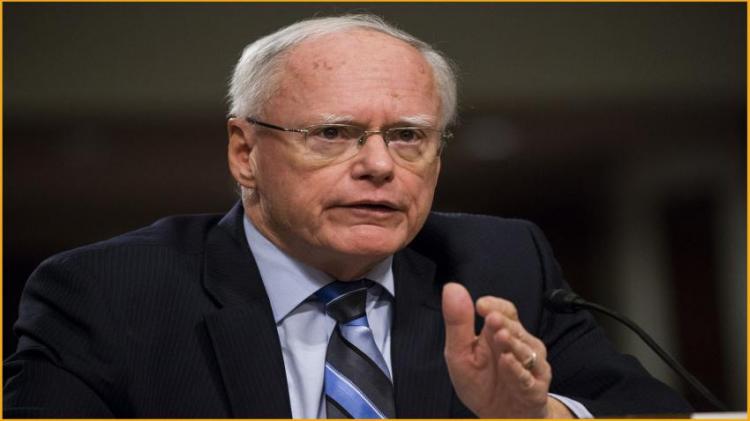
Washington DC – North-Press Agency
Hadeel Uoeiss
In a special interview with North Press, James Jeffrey the United States Special Representative for Syria Engagement and the Special Envoy for the Global Coalition to Defeat ISIS, said that Syria’s Democratic Forces (SDF) were the first to respond to the U.S. call to fight the extremist Islamic State group (ISIS), whose aggression destroyed Syria and reached the U.S. as a local group, the SDF played an active role in defeating the extremist ideology, which the group wanted to prevail, despite its territorial defeat.
Jeffrey said that, the U.S. sees the fight against ISIS as long and prolonged. Therefore, it intends to keep a number of troops for a long time for a sustainable support for the experiment of SDF, both military and civilian so that the U.S. exit doesn’t create any ability for extremist groups to reform and return to target the Syrians, and take Syria as a starting point to prevail extremism in the world.
Jeffrey noted that the U.S. is firmly convinced to maintain the successful experience with SDF in defeating terrorism as the United States coordination with SDF has shifted from domestic cooperation to defeat ISIS to sustainable empowerment of local security forces to train, support, and provide civilian technical assistance to ensure the gains achieved by both sides.
Jeffrey stressed that, the indications monitored by the U.S. in the recent period leads them to stick to stay where the extremist group shows a desire and efforts to return to the experience of building a country within a country from the start of lightning operations, the matter which prompted U.S. Secretary of State Mike Pompeo and President Trump to continue to pressure and extend all countries of the world to participate in the coalition with the necessary resources and everything necessary to ensure a permanent defeat for the group, which poses a threat to the region and to the world.
The Security Mechanism
Regarding the security mechanism, Jeffrey said: “We have entered from the outset to achieve a safe mechanism in the region which ensures the achievement of our primary objective in defeating ISIS, and our consistent vision is to defeat the extremist group and protect our allies on the ground – SDF, to continue fighting terrorism and not abandon their support. So as not to leave a vacuum and (soft) zone filled with extremism, which is the only safe way and goal which we see taking into account the concerns of our allies such as Turkey”.
Jeffrey pointed out that the U.S. adheres to its “priorities not to leave Syria as a safe haven for Iran and its militias”, stressing on the U.S. adherence to prevent Assad and his allies from achieving what they wanted to extend their control and rule on Syria through a military solution, which he described as “failure”.
The dialogue
In light of mounting warnings from the SDF leadership and the U.S. officials that ISIS still imposes threats on the region, do you still have the same resolve to fight the extremist group before other calls for withdrawal and isolationism?
We made it clear repeatedly that even after the defeat of ISIS on the ground, and from the territories it had occupied, ISIS return to Syria and Iraq is still a threat, and this is well understood.
“At this stage, even though ISIS doesn’t have any area of influence, we realize that there is a significant risk of ISIS return, where its sleeper cells are taking practical steps and tactics, whose main objective is to build a state within a state”, he added.
How do you face this danger?
“The Coalition continues to support our partners on the ground in Syria and Iraq, there are daily operations to uproot these remaining cells and counter the operations of the cells.
There are deep, large-scale and systematic clearance operations to prevent possible attacks and achieve sustainable stability for local people”, Jeffrey said.
Even, President Trump and Secretary of State Pompeo made it very clear that we will continue to exert pressure and implement what we have started to make it a sustainable triumph. President and Secretary of State pledged to continue to press and provide the region and all the countries fighting ISIS with everything necessary to ensure a permanent defeat of this group, which poses a threat to our homeland (The United States) and on the security of our partners.
One of the indicators of the danger of the persistence of conviction by some groups of the “Islamic State”, what we see from the scenes published by media from al-Hawl camp, which includes tens of thousands of remnants of the group..
How do you deal with this danger?
al-Hawl camp and other refugee camps in north and east of Syria are a real concern for us, we recognize that, it is a long-term security challenge, as well as it is a great human tragedy which requires international consensus and joint global efforts to find sustainable solutions. This is one of the evidences that, the Coalition must continue to be coherent and focus on the fundamental goal of defeating extremism.
We provide humanitarian assistance and we share with the local security authorities of the SDF to try to keep security in the camp, but we have no direct authority over the camp.
US partners and other aid agencies are making efforts to respond to the humanitarian tragedy following the massive influx of refugees last winter. Conditions are getting better in the camps as the humanitarian situation improves and services increase. There are now three field hospitals, health clinics, better sanitation facilities and areas for some kind of recreational activities for children.
The other dilemma in al-Hawl camp is that it includes both the victims and the criminals. There are believers of ISIS, the prisoners of this group and their child victims.
The plan is to encourage the reintegration of innocent people in the camp with their communities of origin in Syria, Iraq and other countries later, but the cooperation from the international community is required.
How do you explain the arrival of ISIS and its ideas within the Western and U.S. societies to convince Western citizens to launch offensives in the name of the group, and do you think that the fight against extremism by a predominantly Muslim and Middle Eastern group – the Syrian Democratic Forces – and its defeat contribute to the weakening of the group’s ability to export this propaganda?
Over the past five years, we have had tremendous success against the extremist group, not only on the ground but we have defeated its ideas with the help of local allies – SDF – because of their association with the roots of the region.
ISIS capabilities have been diminished drastically with its defeat on the battlefield. Concerning the war of ideas, the U.S. in cooperation with allies in Syria and the governments of partner countries, waged massive campaigns to defeat the group intellectually. We are also cooperating with the private sector, where our online presence has grown significantly to expose the false propaganda of the group and refute the intellectual terrorism, and what it broadcasts online. We have developed sophisticated ways to combat extremist ideologies in London, UAE, Saudi Arabia and Malaysia to harness the creativity and expertise of local actors to generate positive content that challenges the nihilistic vision of ISIS and its supporters.
In terms of the private sector, we are working closely with companies such as Google, Facebook, Telegram and others to be careful and immediately remove violent extremist content from their platforms that violate the terms of services provided by these companies. Since August 2015 Twitter has deleted more than 1.2 million accounts linked to the terrorists or affiliated with them, this proves the misuse of platforms while this is a complex challenge that remains to be done through concerted efforts.
We want to create a global atmosphere that makes it difficult for ISIS to spread toxic ideology in weak and vulnerable societies.
In light of all talks about the serious dangers that threaten the region and the world from the extremist “Islamic State”, Turkey says that it wants to change the regional body to establish a zone called “safe” to be cut off from Syria, where did the talk about this issue arrived and what are your priorities?
Our main goal for which we entered and what we see is that we only want to achieve a “safe mechanism” to ensure the defeat of ISIS permanently. We believe that the security mechanism that we are working on, as we have explained in the past, leads automatically to security and stability in the region.
Our vision, which is the vision of the U.S. President isn’t to create a vacuum or weak areas through which ISIS could infiltrate through our withdrawal or stop of our support and influence, a vision agreed upon and wanted by the President of the United States of America Donald Trump.
In this way, we have also addressed Turkey’s legitimate security concerns, but we also protected our allies on the ground – SDF – in their war against ISIS.
In light of a general U.S. political orientation towards isolationism and troop withdrawal, do you think you have provided and will provide the SDF with the tools, support, strength and confidence needed to ensure lasting security for the region, if the U.S. moves away by a future withdrawal that might happen to the U.S. soldiers?
First, President Trump said that a small part of our forces will remain in the northeast to ensure that ISIS won’t return, and to support the stability and security of the north and east of Syria.
There is U.S. group, albeit a small one, that will remain for a long time in the north and east of Syria to coordinate with our allies on the ground, the SDF.
The reason for all this is that the SDF was the first to respond to our call to cooperate and seek partners to fight and defeat terrorism, our common enemy. We are grateful for the sacrifices, courage, dedication and seriousness of the SDF to clear the north and east of Syria from the extremist Islamic State.
Now our cooperation with SDF has transferred from cooperating on the regional defeat of the extremist group to enabling local security to prevent the emergence of disguised networks of ISIS, we also continue to provide support, training, civilian technical assistance, counter-terrorism campaigns and support for their stabilization efforts.
Finally, what about your strategy regarding Russia, Iran and Assad who fought and killed thousands of Syrians but didn’t move towards the most dangerous outposts which encouraged the extremist groups to head towards globalism, especially the so-called “capital of the caliphate” Raqqa?
In addition to the defeat of extremism permanently, the clear objectives of the U.S. events of irreversible progress on a political settlement consistent with Security Council Resolution 2254, and the removal of all forces supported and associated with Iran.
The military solution that the Syrian regime hoped to achieve with the help of Russia and Iran won’t and wouldn’t bring peace.
The only solution to end the unnecessary violence which is launched by them, the economic hardships of the Syrians and the uncertainty that the Syrians still continue to suffer from, is to achieve a political solution which achieves the regional peace and adheres to the unity of Syria under a fair leadership, and according to Security Council resolutions, but it must include full, comprehensive and fair representation of all Syrians to achieve a peaceful and securable Syria.