

DEIR EZ-ZOR, Syria (North Press) – Between the mud-brick houses of the town of al-Shaafa in the eastern countryside of Deir ez-Zor, eastern Syria, Umm Abdullah sits with her young children on the floor of a room whose wooden walls barely hold up its doors and windows.
The heavy air—thick with the smell of sulfur and black smoke—chokes them daily. Even a light breeze is enough to carry toxins into their lungs, making breathing difficult and nights unbearably long. For them, there is no longer a difference between day and night—the air itself has become a silent enemy.
Amid the overlapping crises that have battered Syria for years, a quiet environmental and health disaster is emerging, threatening the lives of thousands in the eastern countryside. Here, makeshift refineries that burn crude oil release their toxins into the air, adding a new kind of war to a region already exhausted by years of conflict.
Daily source of poison
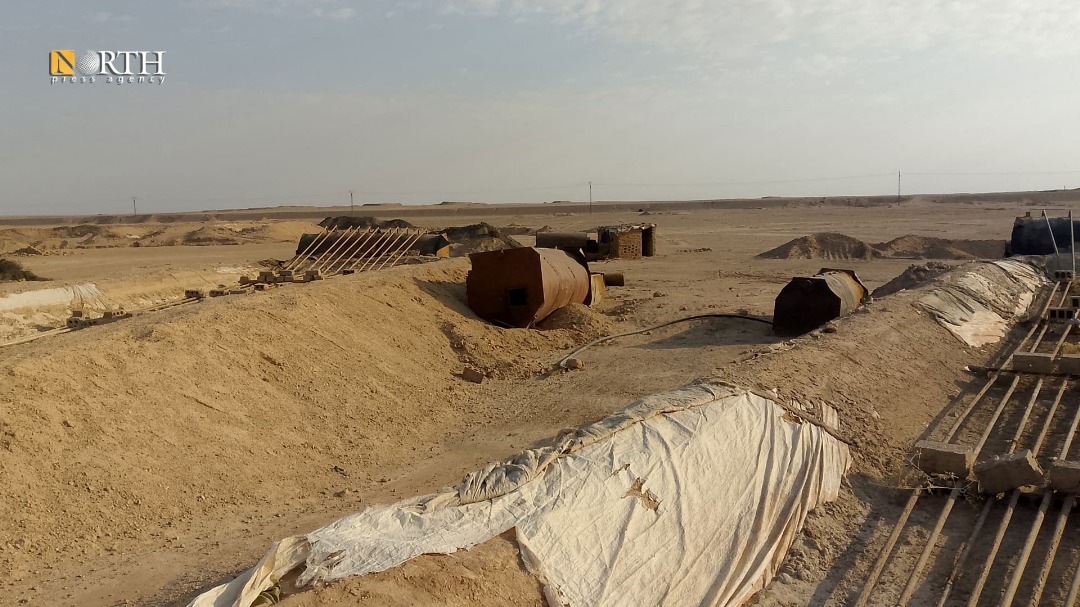
As battles intensified across the country and most oil extraction operations came to a halt, residents turned to burning crude oil in makeshift outdoor refineries. The goal was to extract fuel derivatives, but the process releases massive amounts of toxic gases and fine particles that pollute the air, soil, and water—causing severe respiratory and skin illnesses, especially among women and children who spend most of their time indoors.
The crisis is worsened by extreme poverty. Residents are trapped between working in this dangerous environment and protecting their families’ health. The consequence is the daily inhalation of poison, with no real alternatives. Officials visit the area occasionally and promise solutions, but nothing changes on the ground. As Umm Abdullah tells North Press, “Our lives have become trapped in this black smoke.”
Fifty-year-old Umm Abdullah recounts her story in a weary voice. “We can no longer distinguish day from night. The smell of sulfur and burnt materials hangs over our home and our hearts. On nights when the wind blows toward our town, the air becomes so heavy we can barely breathe. We’re forced to seal the windows and doors as if we were in a gas chamber.”
She points to her teenage daughter, who suffers from asthma, “She used to be one of the top students in her school, but now she misses many days because of shortness of breath and asthma diagnosed by the doctor. Medicine is expensive and not enough. Many of my neighbors suffer from skin diseases and eye allergies. We pray God protects our children, but until when? We are trapped and cannot afford to move elsewhere. Here, we face slow death every single day.”
Between illness and hunger
Abboud al-Sultan, owner of a makeshift oil refinery from the town of Diban, speaks to North Press, “I know that I do harms people and that the smoke is toxic, but after the war there was no work left.”
“These refineries are the only source of income for my family of four. I am not a big trader—just someone trying to survive. Hundreds of refineries operate in our town, supporting hundreds of families who have no other option.”
He continues, “Sometimes I try to run the refineries at night when people are asleep to reduce the harm, but the demand for diesel and gasoline is high, and I cannot delay the work. If the government or international organizations provide cleaner technology, we will be the first to comply. But if I am asked to shut down the only livelihood my children have, that is a bigger problem than the smoke. Here, everyone is trapped between two fires, the fire of illness and the fire of hunger.”
Health impacts
Fouad al-Saleh, an environmental and health activist from the Deir ez-Zor countryside, tells North Press, “What is happening in Deir ez-Zor countryside is an environmental and health crime in every sense of the word. The gases emitted from the refineries and wells are not just annoying smoke, they are a deadly mix of carbon monoxide, sulfur dioxide, hydrogen sulfide, volatile organic compounds such as benzene, and fine particles that penetrate the lungs and enter the bloodstream.”
He adds, “The health impact is terrifying. We are recording increasing cases of severe asthma, chronic lung infections, and throat and lung cancers—especially among children. Pregnant women are affected too, with hospitals reporting miscarriages and congenital malformations. The problem is cumulative—even if the pollution stopped today, its effects would appear years later. There is zero environmental monitoring, and no hospitals equipped to treat these chronic diseases.”
The international community ignores this disaster because it is slow-moving and does not produce dramatic images like bombings, he says. Yet the long-term death toll will exceed any war.
Ahmad al-Saeed, an official from the Environment Office of the Syrian transitional government tells North Press, “We recognize the seriousness of the problem and suffer from it just like everyone else, but our capabilities are extremely limited. We do not have the authority to forcibly shut down the refineries, because doing so would trigger a social explosion—thousands of families depend on this informal sector. The solution is not simple and requires real economic alternatives, cleaner technology, and designated industrial zones far from residential areas.”
He adds, “We are trying to monitor air quality, but implementation remains slow. There are ongoing discussions with international organizations to study the creation of industrial zones outside populated areas, but this requires major funding and political will. Awareness campaigns and distributing masks are temporary solutions. They do not address the root of the problem.”
Environmental and engineering dimensions
From an engineering perspective, the disaster is doubled. Al-Saeed says makeshift oil refineries perform incomplete combustion of fuel, producing emissions a hundred times higher than modern industrial facilities. Associated Petroleum Gas (APG) is not only a wasted energy resource but also a major source of Greenhouse Gases, with black soot, or black carbon, directly contributing to climate change.
The tragedy of Deir ez-Zor’s countryside is a stark example of how residents, particularly women and children, have become victims of environmental catastrophes threatening the health security of future generations. The problem runs far deeper than the smoke; it is rooted in profound economic and social conditions.
Addressing these causes requires immediate action. Time is running out, and every day without a solution adds another layer of suffering that weighs on the lives and dreams of the region’s residents.
Between the refineries and the smoke, people are fighting a silent battle for survival—caught between the fire of illness and the fire of hunger, while the very air they breathe has turned into a deadly enemy.
Reporting by Omar Abdurrahman