

DAMASCUS, Syria (North Press) – From Damascus to Hasakah and Deir ez-Zor, from Kobani to Idlib, thousands of Syrians have been forced to flee their homes since the war began, escaping the violence of the Islamic State (ISIS), detention, poverty, and economic collapse.
Today, these displaced Syrians have sought refuge in countries such as Germany, the Netherlands, Sweden, Austria, the UK, Canada, and Switzerland. Despite the differences in their journeys and experiences, they share common concerns: Syria’s security and economic stability, the possibility of return, and the sources they rely on for news about their homeland.
Through its network of correspondents, North Press has reached out to Syrians abroad via social media to gather their views on the prospect of returning and their perceptions of Syria today.
Security and economic conditions in Syria
Mohammed al-Hajjar, who was released from detention in 2022 and fled Syria shortly thereafter, reports a “relative improvement” in security and the economy following the fall of the Assad regime. However, he still lives in fear of arrest and retaliation. From his home in Germany, he describes the Syrian economy as “paralyzed,” with limited job opportunities and prices rising faster than wages can keep up.
Samer Hammoud, who left Aleppo for Sweden in 2015, recalls his city’s destruction after years of bombardment and siege. Similarly, Noor Hassoun, who migrated from Idlib to Germany, says returning home is nearly impossible due to the widespread destruction of infrastructure and homes. Both agree that despite some relative improvements, security remains fragile and the economy exhausted, with Syria no longer resembling the country they once knew.
Raslan, from rural Damascus, fled in 2016 after his brother was arrested and tortured. Describing Syria as “unstable” from his new home in Germany, he still holds hope of contributing to its reconstruction one day.
Women’s experiences echo those of the men, with many facing the hardships of living in exile. Gule Hassan, originally from Qamishli, now living in Iraq’s Kurdistan Region, describes life in Syria as “very hard,” citing insecurity as the main barrier to safe living conditions. Hemrin Ali, who relocated to Switzerland a decade ago, adds that poverty is spreading across Syria, with inflation making life increasingly untenable.
In Kobani, Jamil Mesho, 44, recalls the devastation of 2014 when ISIS seized his city. He describes it as a “total collapse of daily life,” with residents living in constant threat of violence. After fleeing to Turkey, witnessing battles against ISIS, and eventually settling in the Netherlands, Mesho now sees Syria’s economy as “devastated” by war, currency collapse, and poverty. Security remains uncertain, he says, due to sectarian tensions and the presence of Turkish-backed armed factions.
Mesho, who has built a new life in the Netherlands, emphasizes the difficulty of returning. He has learned the language, works in asylum services and translation, and watches his children integrate into Dutch schools, all of which make the prospect of return seem almost impossible.
Similarly, Marwan Othman, 47, fled Kobani in 2014 due to ISIS and now describes the situation in Kurdish-majority areas as “relatively stable but fragile.” While some areas may seem calm, Othman notes that fear still lingers beneath the surface. The economy is in dire straits, with over half the population living below the poverty line. He points to the collapse of essential services like education and healthcare, noting that any economic recovery remains distant.
Abdullah al-Khaled, from Deir ez-Zor, who fled in 2014 after witnessing ISIS atrocities, says the situation has “improved somewhat” but that Syria’s recovery will take a long time after 14 years of conflict.
Ali al-Ibrahim, originally from al-Mayadin, left in 2017 after the Assad regime and Russian forces took control of his hometown. Living in Austria now, he believes Syria could “move toward recovery” if both security and the economy improve together.
Mahmoud al-Tamr, a journalist, calls the security situation “chaotic,” citing the presence of ISIS sleeper cells, while describing the economy as “strangling,” with soaring prices and few job opportunities. In Germany, 27-year-old journalist Wahaj Azzam sees little change, noting that while “illusory” investments have been promised, the security situation remains “catastrophic,” with arbitrary arrests and revenge killings still widespread across Syria.
For some, there are signs of improvement. Alaa Mohammed, 35, who left Damascus in October 2014 to avoid compulsory military service, believes conditions are better than under the Assad regime but acknowledges the long road ahead. Similarly, Yara Ismail, 37, a nurse who fled Syria in 2014, says security is “bad,” though she believes the economy is showing some signs of recovery. Abdulhadi D’aas, 28, who left Damascus in 2021 due to economic hardship and military service, is cautiously optimistic, hoping for change in the future.
In contrast, Haytham Othman, 25, who left for Germany in 2024 to avoid conscription and economic decline, believes that while the economy has improved slightly, security has deteriorated.
From Hasakah, Jihad Issa Sheikhmous, 54, who emigrated to Germany in 1996 due to economic hardship, says conditions remain “very difficult” and unlivable for most Syrians.
Rami Issa, 29, a former activist from Hasakah who left in 2019 due to security threats, describes the security situation as “miserable” but acknowledges that the economy has improved slightly. However, he believes geographic fragmentation is a major obstacle to stability.
Majed al-Youssef, 30, rejects the idea of returning to Syria, citing the stark contrasts in freedoms and wages between Europe and his homeland. Belqis Abbas, 40, a mother of three from Sere Kaniye (Ras al-Ain), who fled in 2013 after an ISIS attack, also believes returning is not feasible, noting that security remains unstable and the economy has collapsed.
Adnan Majoul, 50, from Tel Tamr in the Hasakah countryside, who now lives in Germany, sums up the sentiment shared by many: “Security is deteriorating, and the economy is extremely difficult.”
The idea of return to Syria
Most Syrians abroad who spoke to North Press agree that current conditions in Syria “do not allow for return.”
For Jamil Mesho, the integration of his children into Dutch society and his stable work make returning nearly impossible. Marwan Othman points to fragile security and collapsed services as major obstacles, while Majed al-Youssef cites the stark gap in freedoms and income as decisive factors. Jevin Hassan, living in Canada, describes return as “currently impossible,” although she follows developments on Facebook.
Some Syrians, however, still hold on to limited hope. Raslan dreams of contributing to Syria’s reconstruction, while Ali al-Ibrahim sees potential if security and the economy improve together. Others approach the idea with cautious optimism, like Abdulhadi D’aas, whereas some young people, including Haitham Othman, remain pessimistic.
News sources and information networks
The ways Syrians abroad follow the news illustrate the complexity of their situation and the difficulties of verifying information from their homeland.
Jamil Mesho relies on a combination of Kurdish, Arab, and Dutch TV channels, alongside trusted journalists’ Facebook pages. Ibrahim Sinjar, 55, follows both traditional media and social platforms, while Marwan Othman depends on “news agencies, journalists, and activists on social media.”
Hadi Bedrkhan, 43, uses “news channels and WhatsApp conversations with friends,” and Bozan Mahmoud, 29, sticks primarily to Facebook news pages. Khedr Mohammed, 49, explained: “My information comes from WhatsApp and Facebook, because events change quickly and I need constantly updated sources.”
Women also employ diverse methods. Gule Hassan follows news via Facebook and WhatsApp, while Nour Mohammed Ali relies on “journalists and activists on Facebook and Twitter, as well as newer Syrian media outlets she considers more transparent.” Rojin Hassan consults both social media and TV channels, while Jevin Hassan mainly uses Facebook.
Since the fall of al-Assad’s regime in December 2024, Syrians have become more cautious about consuming news. Jivan Qaso, in Germany for 11 years, continues to rely on Facebook and TV. Malek Khalouf al-Alaw, 34, follows “social media and relatives in Syria,” while Wahaj Azzam, 27, combines “social media with private, trusted sources.”
Alaa Mohammed, 35, sources news from “Facebook, Al Jazeera, Al Arabiya, and family and friends,” whereas Yara Ismail, 37, says: “90 percent of my news comes from Facebook, the rest from Al Jazeera and Syrian channel al-Ikhbariya.” Even journalist Abdulhadi D’aas, 28, uses “official outlets like Sky News, CNN, and CNBC,” while engineer Haytham Othman, 25, follows “Facebook, YouTube, and specialized channels.”
Jihad Issa Sheikhmous, 54, continues to consult Facebook, TV, and relatives, while Rami Issa and Majed al-Youssef rely on networks of friends in journalism and social media.
The varied sources reflect both the uncertainty in Syria and the desire of Syrians abroad to remain connected to their homeland despite the risks and challenges of navigating a fragmented media landscape.
Statistics on security, economy, return, and news sources
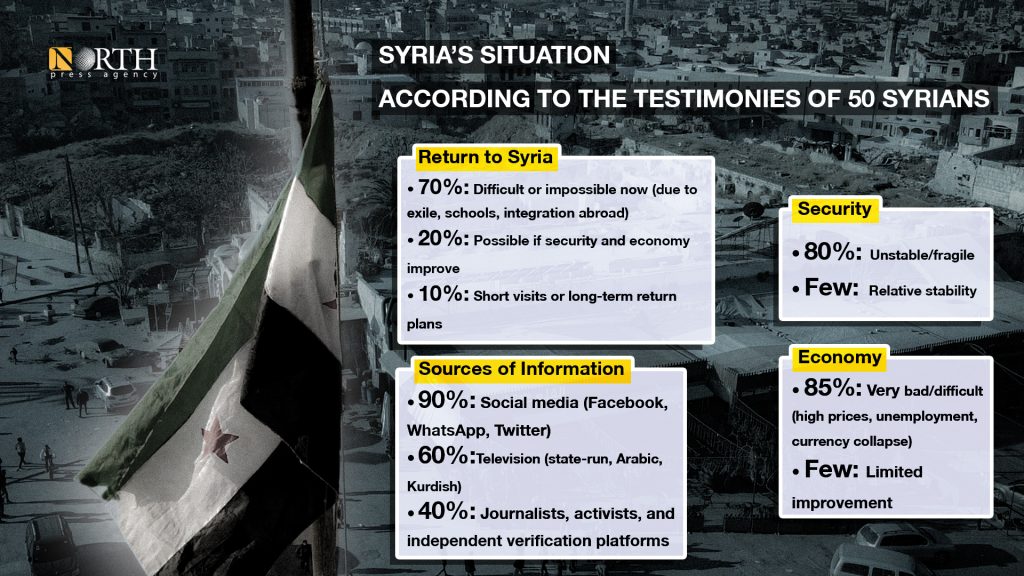
Based on testimonies from over 50 Syrians surveyed for this report, nearly 80 percent described Syria’s security situation as “unstable” or “fragile.”
Around 85 percent characterized the economy as “very bad” or “difficult,” citing soaring prices, high unemployment, and currency collapse. Only a small minority noted slight improvements or relative stability in certain areas.
Regarding the possibility of return, more than 70 percent said going back is difficult or impossible, primarily due to their children’s integration abroad and established lives in host countries. About 20 percent indicated that return might be possible if both security and the economy improve, while roughly 10 percent reported that they only visit Syria temporarily or plan a long-term return.
When it comes to sources of information, nearly 90 percent rely on social media platforms such as Facebook, WhatsApp, and Twitter. Approximately 60 percent follow TV channels—Syrian, Kurdish, or Arab—while 40 percent depend on trusted journalists, activists, or independent verification platforms to stay informed.